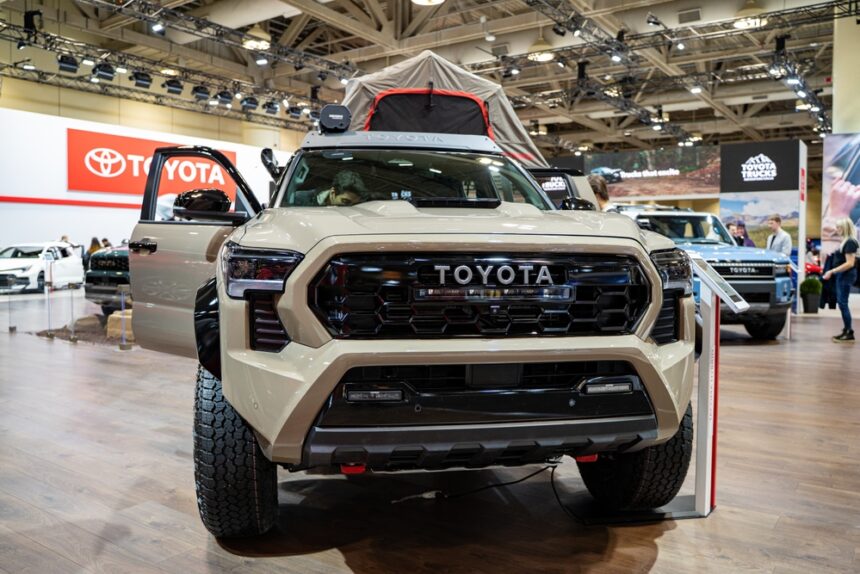
Toyota Motor North America announced a $3.6 billion investment to expand its manufacturing campus in San Antonio, Texas, adding a second assembly line dedicated to Tacoma pickup truck production while transitioning that manufacturing from its facility in Baja California, Mexico over approximately four years.
The expansion will add 2.5 million square feet to the existing San Antonio site, doubling its total footprint and creating 2,000 new jobs by 2030. The plant currently employs more than 3,700 people across a 2.2-million-square-foot facility that produces the Tundra pickup truck and Sequoia sport utility vehicle, manufacturing nearly 200,000 vehicles last year.
What the expansion involves
The investment will add a dedicated Tacoma assembly line alongside the existing vehicle assembly line and a rear axle plant that is currently approaching its startup phase. When the expansion reaches full production, the San Antonio campus will handle Tacoma manufacturing that had previously been based at Toyota’s facility in Baja California, consolidating a significant portion of the company’s North American truck production within a single Texas location.
Toyota operates 10 manufacturing sites across the United States, and San Antonio’s expansion would make it substantially larger than its current scale. The four-year transition timeline reflects the logistical complexity of moving truck production from one facility to another while maintaining supply commitments and avoiding disruption to existing manufacturing operations at both sites.
The tariff context driving the decision
The announcement arrives more than a year after the Trump administration implemented tariffs on imported automobiles and automotive parts, a policy environment that has created significant financial pressure on automakers with manufacturing operations in Mexico and other countries subject to those levies.
Toyota acknowledged earlier this year that the tariff costs associated with its current production structure were substantial, with the company’s chief risk officer indicating during an earnings briefing in May that rising tariff duties had cost the company approximately $8.8 billion during the fiscal year ending in March. That figure underscores the magnitude of the financial burden that has accelerated the industry-wide reassessment of where vehicles and parts are manufactured.
Moving Tacoma production from a Mexican facility to a Texas plant directly reduces exposure to the import tariffs that apply to vehicles manufactured outside the United States, making the investment economically rational as a tariff mitigation strategy in addition to its significance as a commitment to American manufacturing capacity.
The broader significance
Toyota’s San Antonio expansion is part of a broader pattern of automotive manufacturers responding to the current trade environment by investing in or expanding US-based production. The combination of tariff pressure, political emphasis on domestic manufacturing, and the desire to demonstrate commitment to American workers and communities has accelerated decisions that might otherwise have played out over longer timelines.
The 2,000 jobs the expansion will create in San Antonio represent a significant economic development for the region, adding to an existing manufacturing base that already supports thousands of workers. Texas has been actively competing for large-scale manufacturing investments, and Toyota’s decision to double its footprint there reflects the state’s continued attractiveness for automotive production given its infrastructure, workforce, and business environment.
Toyota’s total investment in US manufacturing operations has grown substantially over recent years, and the $3.6 billion San Antonio commitment adds to a capital expenditure pattern that positions the company as one of the larger foreign investors in American automotive production.