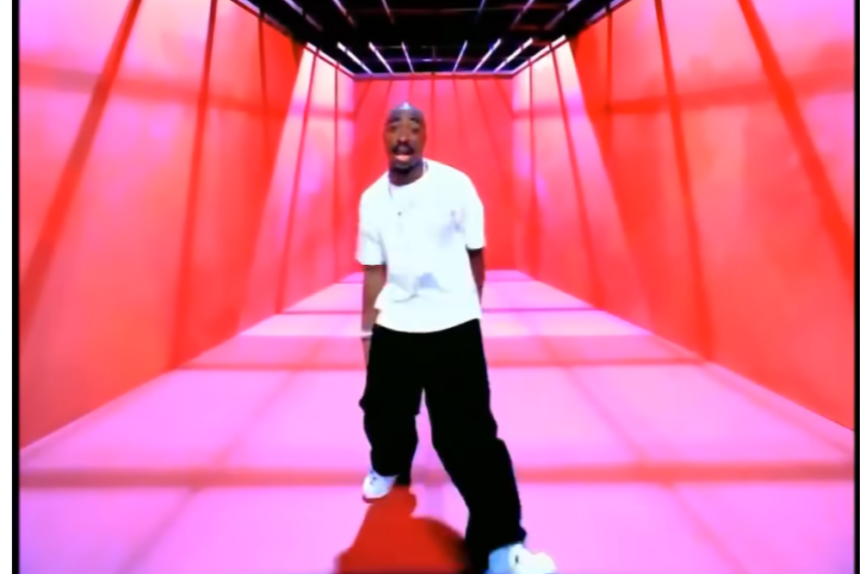
There are rap songs and then there are moments that reroute the entire culture. 2Pac’s ‘Hit ‘Em Up,’ released 30 years ago today, was the second kind. It arrived not as music so much as a detonation, a three-minute-and-fifty-second declaration of war that leveled everything around it and left hip-hop permanently changed.
The song has never stopped being discussed, referenced, or measured against. Three decades on, nothing has clearly surpassed it.
The feud that made 2Pac reach for the record button
By mid-1996, the East Coast vs. West Coast rivalry had become the dominant storyline in American music. 2Pac was signed to Death Row Records, aligned with Los Angeles and the West, and publicly at war with The Notorious B.I.G. and Bad Boy Entertainment out of New York. What had started as a personal conflict between two of the most talented rappers of their generation had expanded into something the entire industry was watching.
The tension had roots in a 1994 shooting at a New York recording studio in which 2Pac was robbed and shot five times. He later implied, without ever producing proof, that people close to Biggie had known about it in advance. By the time ‘Hit ‘Em Up’ arrived in June 1996 as a B-side to the single “How Do U Want It,” 2Pac was not interested in subtext. He went directly at Biggie, Bad Boy, and anyone else he wanted to reach.
What 2Pac actually built on that record
The production underneath ‘Hit ‘Em Up’ is deceptively straightforward. A heavy piano loop anchors the track, giving it a theatrical weight that matches 2Pac’s delivery. The arrangement does not try to be subtle. It wants to feel like a confrontation and it succeeds.
What makes the record hold up is not just the aggression but the construction. 2Pac moves between personal attacks, regional declarations, and wider callouts with a precision that sounds effortless and almost certainly was not. The Outlawz appear on the track as well, piling on with the kind of energy that would make the record feel less like a solo response and more like a full squad putting someone on notice.
The opening lines landed immediately and have never left the culture. They are among the most quoted in rap history, recited by fans who were not yet born when the song dropped.
Why ‘Hit ‘Em Up’ still sets the standard for diss tracks
Every major rap diss record released after June 4, 1996 has been compared to this one. Nas’s Ether against Jay-Z in 2001 gets mentioned in the same breath. Drake’s “Push Ups” and Kendrick Lamar’s “Not Like Us” renewed the conversation in 2024 and both immediately drew comparisons back to 2Pac. The template has never really changed because ‘Hit ‘Em Up’ set it so completely: name your target, make it personal, make it undeniable, leave nothing open to interpretation.
What separates the record from its imitators is the lack of distance between 2Pac and the material. He was not performing anger. He was expressing it, and listeners have always been able to tell the difference. That authenticity, whatever its costs, is what makes the track feel like a primary document rather than a performance.
What 2Pac’s 30-year-old record leaves behind
Both men at the center of this feud were dead within 15 months of the song’s release. 2Pac was shot in Las Vegas in September 1996 and died six days later. Biggie was killed in Los Angeles in March 1997. The rivalry that produced ‘Hit ‘Em Up’ ended in a way that stripped the song of any triumphant feeling it might otherwise carry.
What remains is complicated. The record is a landmark and also a document of a conflict that destroyed two lives and left the genre genuinely diminished. Hip-hop in the late 1990s never quite recovered the particular energy those two artists carried at their peaks.
Still, ‘Hit ‘Em Up’ endures because the craft inside it endures. 2Pac recorded something so direct and so fully realized that 30 years of attempts to replicate it have not produced anything that clearly stands above it. That is its own kind of legacy.