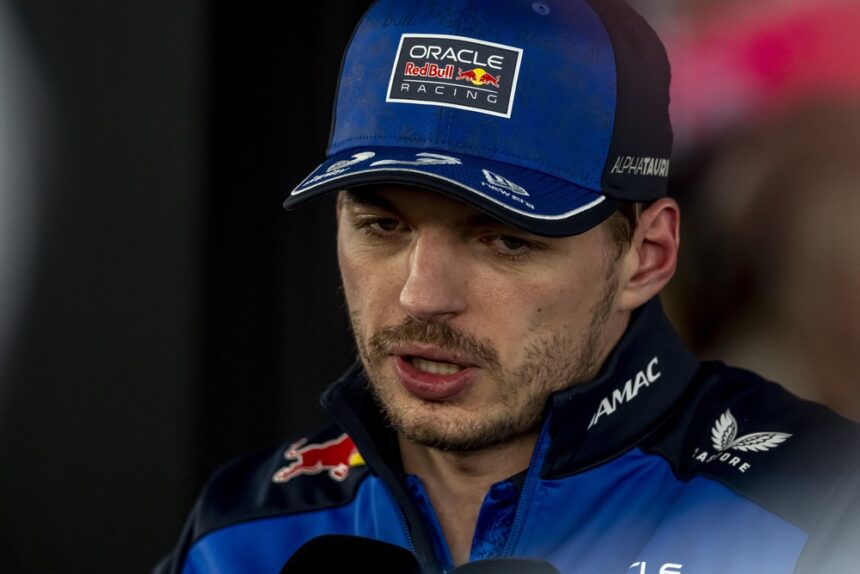
Red Bull team principal Laurent Mekies acknowledged that Max Verstappen was fully justified in his anger after a rear wing failure caused the four-time world champion to spin out of the British Grand Prix at Silverstone, the second consecutive race in which a high-speed wing problem ended his afternoon.
Verstappen was running third when his car lost rear downforce approaching the fast right-hand corner at Stowe, causing a spin that left him beached in the gravel and unable to continue. Red Bull traced the issue to the rear wing failing to close properly as it transitioned from its straight-line drag reduction mode back into the downforce-generating position needed for cornering. The team confirmed they could see the wing’s failure to close in the data.
A second wing failure in as many races
The incident followed a high-speed spin during qualifying at the previous round in Austria, where a rear wing problem had also been identified. Red Bull’s team principal drew a distinction between the two issues, saying they were caused by different technical factors rather than the same underlying problem repeating itself, while acknowledging that the distinction offered little comfort given the consequences were identical.
Verstappen‘s language after the British Grand Prix was sharp. He described the car as dangerous, said he had been fortunate not to injure himself, and expressed deep frustration with the situation. His team principal agreed with the assessment rather than defending the team’s performance.
The technical explanation
Under 2026 Formula 1 regulations, all cars are equipped with active aerodynamic systems on both the front and rear wings. The systems work by opening flaps in permitted sections of the track to reduce drag on straights, improving straight-line speed, before snapping shut under braking to restore the downforce needed for cornering. The transition must be reliable and correctly timed to function safely.
Red Bull introduced a rear wing concept at Miami that features an upper plane rotating in an inverted position when the flap opens, a more unconventional approach to the regulation than rivals have adopted. The wing performed without serious incident through several race weekends before the issues at Austria and Silverstone emerged.
The team principal would not rule out reverting to the original wing design if investigation reveals a fundamental problem with the rotating mechanism concept rather than a specific component failure.
What comes next for Red Bull and Verstappen
The two retirements have done significant damage to Verstappen’s championship position, dropping him to seventh in the drivers‘ standings and removing him from the realistic title conversation at a moment when the leading teams are closely matched in performance. He entered the Silverstone weekend with upgrades that had shown genuine pace in Austria before the crash, making the British Grand Prix retirement doubly frustrating.
Speculation about Verstappen’s future at Red Bull has gathered momentum in recent weeks following reports that his management explored conversations with at least one rival team. His public comments about the car’s safety after a second consecutive technical failure add pressure to a situation the team is already navigating carefully.
Mekies gave assurances that the team would leave no option unexplored in addressing the wing reliability issue and committed to ensuring the problem does not repeat at the next event. Whether that means continuing with the current concept under modified parameters or returning to the original design depends on the analysis currently underway.
The British Grand Prix result leaves Red Bull needing both technical resolution and a run of clean race weekends to rebuild Verstappen’s championship position before the deficit becomes insurmountable.