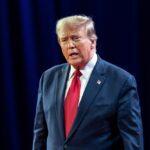
Donald Trump is once again connecting safety concerns to his push for a new White House ballroom, this time following a shooting near the White House gates on Saturday, May 23. The president, 79, took to Truth Social shortly after the incident to argue that the long debated, $400 million construction project is not a luxury it is a national security necessity.
The shooter, identified by the Metropolitan Police Department as 21 year old Nasire Best, allegedly approached the White House complex and opened fire, striking two people before Secret Service agents fatally shot him. A Secret Service spokesperson confirmed to CBS News that Trump was inside the building at the time and was not affected by the incident.
In his Truth Social post recapping the evening, Trump praised law enforcement for what he described as swift and professional action, then pivoted directly to his ballroom pitch, writing that the event underscores the urgent need to build what he has called the most safe and secure space of its kind ever constructed in Washington, D.C., adding that national security demands it.
A second shooting in less than a month sharpens his argument
The May 23 incident came almost exactly four weeks after an assassination attempt at the White House Correspondents Dinner at the Washington Hilton hotel on Saturday, April 25 an event Trump attended. In the immediate aftermath of that shooting, he made repeated public statements arguing that the White House needed its own ballroom precisely to avoid holding large events at outside venues.
Trump noted in his most recent post that the two incidents, separated by roughly a month, reinforce why the project matters not just for his presidency but for all future presidents.
That talking point has become central to how Trump frames the ballroom publicly. Earlier this month, at his second Rose Garden Club dinner on May 11, he described the 90,000 square foot structure as one that will be unlike anything the world has seen, emphasizing its safety features, including glass he claimed would be approximately six inches thick yet perfectly transparent a combination he presented as the highest level of safety available.
The project’s price tag and timeline have both grown
The ballroom proposal has expanded considerably since Trump first floated it. What began as a vision he suggested would cost around $200 million has since been revised to a $400 million price tag double the original estimate. Construction began in October 2025 when the White House East Wing was demolished to make way for the new structure.
Trump has consistently maintained that the project will be funded through private donations from himself and major corporations, rather than taxpayer money. Senate Republicans, however, are separately pushing to include an additional $1 billion in security funding for the project as part of a broader legislative package.
That effort has run into procedural obstacles. Lawmakers attempting to pass a $72 billion funding package covering Immigration and Customs Enforcement, Customs and Border Protection, and other agencies hit a roadblock that has temporarily stalled progress on multiple fronts, including the ballroom funding push.
The military, Trump says, is among the project’s strongest backers
Trump has also recently claimed that military leadership supports the ballroom more than anyone, a framing that positions the project as something broader than a personal preference. That argument mirrors the national security language he used following the Correspondents Dinner shooting and again after the May 23 gate incident.
Whether that framing gains traction with lawmakers and the public remains to be seen. What is clear is that Trump intends to keep making the case and that each security incident near the White House gives him a fresh opportunity to do so.
The ballroom project remains stalled for now, caught between ongoing litigation and a legislative process that has proven more complicated than the administration initially anticipated. Trump, for his part, shows no sign of letting the issue fade quietly.