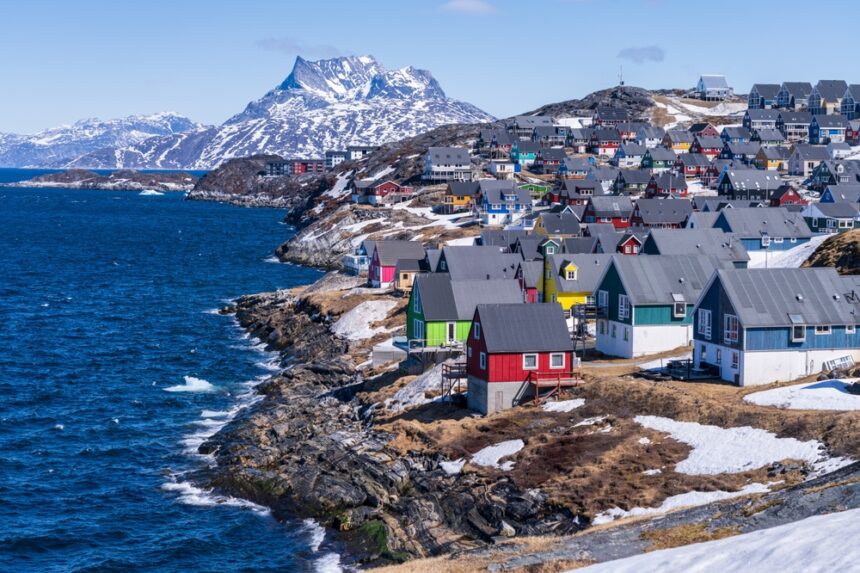
Danish Prime Minister Mette Frederiksen pledged to defend every inch of Danish territory, including Greenland, after President Trump renewed his stated position that the United States should control the autonomous Arctic territory during the NATO summit in Ankara, Turkey on July 8.
Frederiksen was direct in her response, invoking the foundational principle of collective defense enshrined in Article 5 of the NATO charter, the provision requiring member states to treat an attack on one as an attack on all. She framed Denmark’s commitment to defending its territory as both a national obligation and a reminder of what the alliance was built to protect, and she reiterated that Greenland belongs to its people and is not available for acquisition.
Trump’s position and his frustration with NATO
At a press conference during the Ankara summit, Trump expressed dissatisfaction with the alliance on two fronts. He said he was unhappy with NATO’s handling of the Greenland question, which he has consistently characterized as a matter of American national security requiring US control over the strategically located Arctic island. He also described frustration with NATO’s response to Iran during the recent conflict, saying the alliance was unwilling to provide the support he believed the situation warranted.
Trump has made Greenland a recurring theme since his return to the presidency, arguing that American interests in Arctic security, natural resource access, and strategic positioning require a fundamentally different relationship between the United States and the territory than currently exists under Danish sovereignty.
Denmark’s response and the self-determination argument
Frederiksen‘s response at Ankara addressed both the sovereignty question and the broader alliance context. She said Denmark is ready to defend its kingdom and expressed the hope that all allies would respect the Greenlandic people’s right to self-determination, a principle of international law that she positioned as the appropriate framework for any discussion about the territory’s future.
The emphasis on self-determination reflects Denmark’s consistent argument that Greenland’s status is ultimately a matter for Greenlandic people to determine rather than something to be resolved between Copenhagen and Washington. Greenland has significant autonomy within the Danish kingdom and manages its own domestic affairs, though foreign policy and defense remain Danish responsibilities. Greenlandic political leaders have generally resisted American overtures while also pursuing greater independence from Denmark.
Frederiksen’s invocation of Article 5 was notable in its implied direction. While Article 5 is typically discussed in the context of external threats from adversaries, her reference to it in the context of defending every inch of Danish territory including Greenland was a clear signal about how Denmark views any pressure on its territorial integrity, regardless of its source.
The broader NATO context at Ankara
The NATO summit in Ankara has already produced significant friction, with Trump earlier in the summit calling for a complete trade cutoff with Spain over its failure to meet defense spending commitments and its refusal to allow American military access during the Iran conflict. The Greenland confrontation adds another dimension to a summit that has highlighted the degree to which Trump’s approach to alliance management differs from the consensus-building approach that has historically characterized American engagement with NATO.
The public airing of the Greenland dispute at a formal NATO gathering raises questions about how the alliance manages the tension between its largest member’s unilateral assertions about territorial control over land belonging to another member state and the foundational principles of sovereign equality and collective defense on which the organization was built.