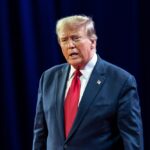
President Trump declared on Tuesday that Iran must be held responsible for shooting down a United States military helicopter near the coast of Oman, warning that a response from Washington was not a matter of if but when.
The incident unfolded late Monday when a US Army AH-64 Apache attack helicopter went down over the Strait of Hormuz at approximately 7:33 p.m. Eastern Time. The US Central Command confirmed the crash in a statement Tuesday, noting that the two crew members aboard were rescued safely within roughly two hours of the aircraft going down. Both pilots emerged uninjured.
Trump, addressing reporters in New York on Monday night before issuing a more forceful statement the following day, confirmed that the crew was safe. By Tuesday, his tone had sharpened considerably. Writing on Truth Social, the president described the helicopter as among the most advanced in the American arsenal and stated that Iranian forces had targeted it while it was on a patrol mission over the strait. He made clear that the United States would not absorb the strike without consequence.
A rescue mission that made history
While the loss of the aircraft drew immediate attention, the operation that followed it also broke new ground. After the Apache went down, a US Navy unmanned surface vessel launched what military officials described as the first known rescue operation of its kind in American military history.
The vessel involved was a 24-foot craft named Corsair, built by Saronic Technologies and assigned to Navy Task Force 59, a unit established in 2021 as the Navy’s first formation dedicated to unmanned systems and artificial intelligence in maritime security. The task force operates across critical waterways in the Middle East, including the Strait of Hormuz and the Suez Canal. The Corsair located the two pilots adrift in open water and brought them safely ashore after approximately two hours at sea.
Military officials confirmed the crash occurred at around 3:30 a.m. local time Tuesday near the Omani coastline, while the helicopter was conducting a patrol.
The Apache’s role in a high-stakes standoff
The AH-64 Apache has been a central instrument in American military operations aimed at intercepting Iranian oil shipments and applying pressure on Tehran to come to the negotiating table. The United States has deployed the aircraft as part of a broader maritime strategy targeting Iranian tankers and cargo movements through the region. The United Arab Emirates has also used the same type of helicopter in operations against Iranian drones.
Since the conflict between the United States and Iran escalated, Tehran moved to block the Strait of Hormuz, a chokepoint through which a significant share of the world’s energy supply passes. The closure sent shockwaves through global energy markets. In response, the United States imposed a blockade on Iranian ports, deepening a standoff that has steadily raised the temperature across the region.
A moment that could define what comes next
The downing of the Apache adds a dangerous new dimension to an already volatile confrontation. Trump’s language on Tuesday left little ambiguity about his intentions. With nuclear negotiations between the two countries still unresolved and military pressure mounting on both sides, the incident over the Strait of Hormuz is quickly becoming the most consequential flashpoint in the standoff yet.
How Washington chooses to respond in the days ahead may determine whether the current conflict stays contained or tips toward something far more serious.