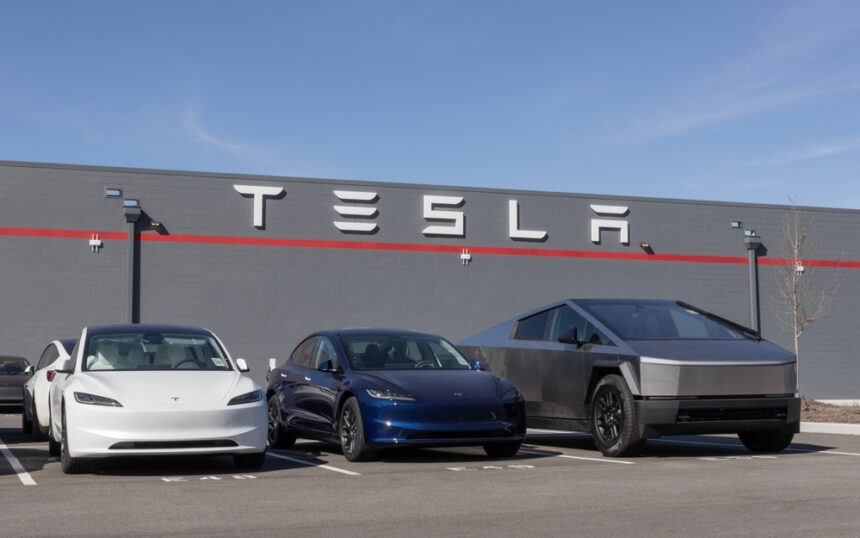
Tesla Model Y made history Thursday when federal regulators declared it the first vehicle ever to pass a new battery of advanced driver-assistance tests — a milestone that raises the bar for an entire industry still catching up to the electric automaker’s safety ambitions.
The announcement came from the National Highway Traffic Safety Administration, which confirmed that the 2026 Tesla Model Y successfully cleared four newly integrated evaluations under the agency’s New Car Assessment Program, widely known as NCAP. The designation applies specifically to Model Y vehicles assembled on or after November 12, 2025 — a cutoff that hints at under-the-hood changes Tesla quietly introduced without public fanfare.
The four tests at the center of Thursday’s announcement cover pedestrian automatic emergency braking, lane keeping assistance, blind spot warning, and blind spot intervention. Together, they represent the kind of real-world, pre-crash scenarios that traditional star ratings have long struggled to capture. NCAP also conducts evaluations for frontal and side crashes, rollover resistance, and crash avoidance — but the four advanced driver-assistance criteria were added in 2024 as part of a broader update to the program.
What the Tesla Model Y Tests Actually Cover
The 2026 Model Y also passed the agency’s existing driver-assistance evaluations, including forward collision warning, crash imminent braking, dynamic brake support, and lane departure warning — meaning the vehicle cleared all eight criteria in the program’s expanded ADAS framework, not just the four new additions.
It remains unclear why only Model Y vehicles built after the November 12 date qualified, or what specific changes Tesla may have introduced to meet the new thresholds. All four of the newly tested features come standard on the 2026 Model Y, and the vehicle already holds a five-star overall safety rating from NHTSA.
A Benchmark That Resets Industry Expectations
The new pass/fail tests were approved by NHTSA in November 2024, effective for the 2026 model year, after being required by Congress. For automakers, the five-star safety rating that NCAP issues carries significant commercial weight — it is among the most scrutinized data points for new car buyers. A strong ADAS result now adds another dimension to that calculus.
NHTSA Administrator Jonathan Morrison called the Tesla result a meaningful turning point. The agency framed the achievement as both a consumer transparency effort and an industry challenge — signaling that it expects other manufacturers to eventually meet the same standard.
Tesla’s Vision-Based System Faces Scrutiny Too
The recognition arrives alongside continued regulatory tension. NHTSA has a number of open investigations into Tesla, including a probe into its Full Self-Driving driver-assistance system over concerns the system may fail to detect or warn drivers in poor visibility conditions.
That duality — top safety marks on one front, active federal scrutiny on another — reflects the complicated position Tesla occupies in the autonomous driving conversation. The company’s vision-based approach, which relies on cameras rather than lidar sensors used by some competitors, has long been a point of debate among safety researchers and engineers.
What This Means for the Rest of the Auto Industry
Tesla’s achievement effectively throws down a challenge to legacy automakers and EV rivals alike. By passing these tests, Tesla demonstrated that its vision-based system can handle complex road scenarios as well as, or better than, traditional setups used by competitors.
Whether Ford, GM, Hyundai, or others can quickly replicate the result remains to be seen. NHTSA has not disclosed which other vehicles are currently being evaluated under the new framework, and the agency has not indicated a timeline for when additional results might be released. For now, the Tesla Model Y stands alone at the top of a safety standard that the rest of the industry will be racing to reach.
Source: Reuters