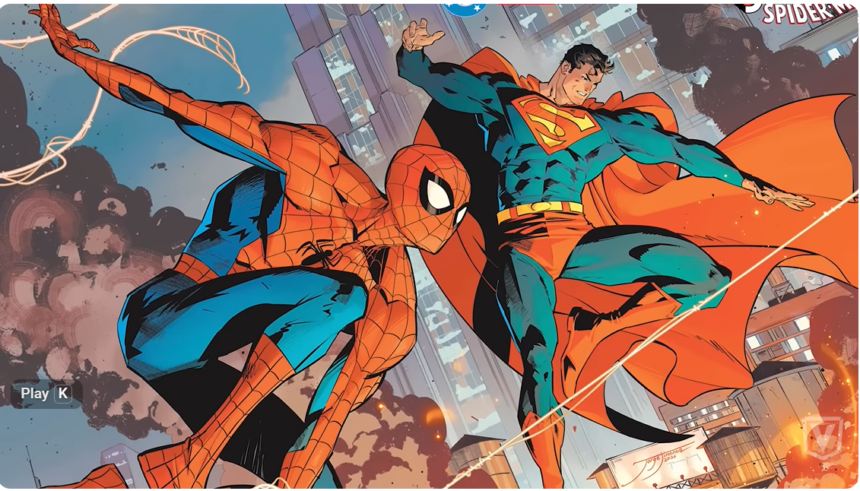
Few collaborations carry the weight of Spider-Man Superman #1. Bringing together Marvel and DC Comics, the issue stands as a reminder of what happens when long standing boundaries are set aside.
At its center are two of the most recognizable figures in comics, Spider-Man and Superman. Their meeting is not framed as spectacle alone. Instead, it leans into personality, contrast and shared purpose.
Spider-Man meets Superman in motion
The story begins in confinement, placing both heroes in a setting that forces immediate cooperation. The tone shifts quickly between humor and urgency. Spider-Man’s quick wit plays against Superman’s steadier presence, creating a dynamic that feels natural rather than forced.
That balance is disrupted when an attack involving Green Goblin introduces Kryptonite into the mix. The result is immediate vulnerability for Superman and a surge of responsibility for Spider-Man.
The sequence that follows leans into action, but it is grounded in character. Spider-Man is not simply reacting. He is holding everything together, both physically and emotionally.
A darker twist with Venom
The narrative expands with the reveal of Venom as a central force. What begins as a confined escape shifts into something more unpredictable when Superman becomes entangled with the symbiote.
The transformation into a Venomized Superman adds a striking visual and thematic layer. It pushes the story into unfamiliar territory while testing the limits of both characters. For Spider-Man, the challenge becomes more personal. He is no longer just saving a partner but confronting a version of power that feels distorted.
Spider-Man and the weight of guilt
Amid the action, the story slows enough to explore emotional ground. For Spider-Man, that means revisiting the influence of Uncle Ben. His sense of responsibility remains central, shaping how he responds under pressure.
Superman offers a counterpoint. His outlook is defined by optimism and clarity, creating a contrast that gives their interaction depth. The conversation between them does not interrupt the story. It strengthens it, grounding the spectacle in something more human.
Expanding the world beyond Spider-Man
The issue extends beyond its main narrative through additional stories that broaden the crossover. One pairs Spider-Man Noir with an early version of Superman, creating a link between different eras of storytelling.
Another brings together Jane Foster as Thor and Wonder Woman, placing them against a shared threat. The inclusion of Miles Morales adds a quieter moment, focusing on guidance and identity rather than conflict.
These stories reinforce the central idea that the crossover is not limited to spectacle. It is also about connection across different versions of heroism.
Why Spider-Man anchors the story
While both heroes share the spotlight, Spider-Man often becomes the emotional center. His vulnerability and humor create an entry point for the reader. He reacts, questions and adapts in ways that feel immediate.
Superman, by contrast, represents stability. Together, they form a balance that carries the story forward. The success of the issue depends on that contrast, allowing each character to highlight the strengths of the other.
A crossover that feels complete
Spider-Man Superman #1 works because it does not rely solely on the novelty of its pairing. It builds a story that respects both characters while exploring new possibilities.
The result is a crossover that feels purposeful. It delivers action, but it also takes time to examine what drives its heroes. That combination gives the issue a sense of completeness that many crossovers struggle to achieve.
For readers, it offers more than a meeting of icons. It presents a story where those icons are allowed to grow, even within a single issue.