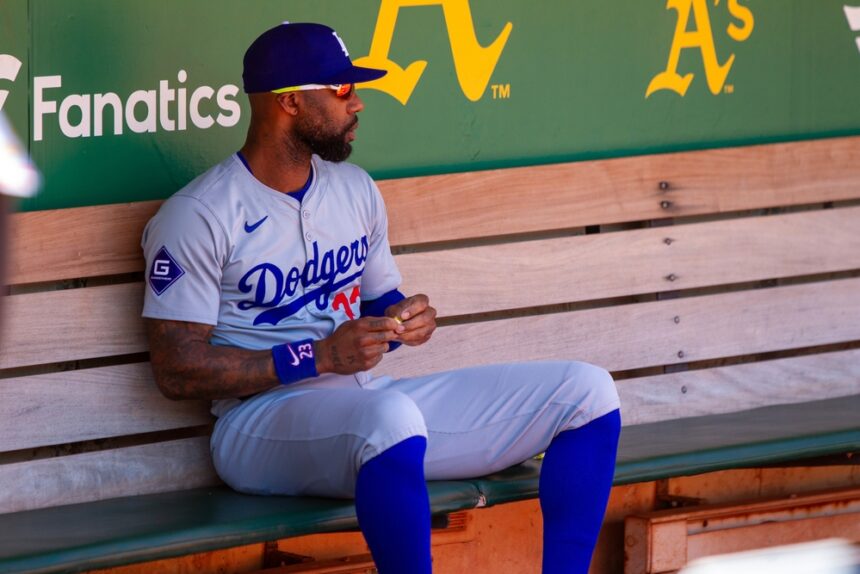
Jason Heyward was supposed to be untouchable. When he stepped onto the field as a 20-year-old with the Atlanta Braves on Opening Day 2010, the buzz surrounding him was unlike anything the sport had seen in years. Tall, athletic, and impossibly gifted, Heyward carried the kind of presence that made scouts run out of adjectives. On March 27, 2026, that journey came to a close as Heyward officially announced his retirement on MLB Network — 16 seasons, six teams, and a legacy far more layered than any stat line could capture.
Heyward’s Unforgettable Debut
The moment was instant. In his very first major league at-bat on April 5, 2010, Heyward launched a home run — a jaw-dropping introduction that seemed to signal the arrival of a generational talent. He finished that rookie season with 18 home runs, 72 RBI, and a .277 batting average, earning an All-Star selection and finishing second in NL Rookie of the Year voting. Nearly 20 fWAR in his first five seasons as a Brave cemented his standing as one of the most exciting young players in the game. He was drafted 14th overall by Atlanta in 2007 from Henry County High School in Georgia, and every step of his early climb looked like destiny unfolding.
A Glove for the Ages
Whatever questions followed Heyward’s bat, his glove was never one of them. He won five Gold Glove Awards across his career — in 2012, 2014, 2015, 2016, and 2017 — and was widely regarded as one of the most elite outfield defenders the sport has ever seen. He also took home the Wilson MLB Defensive Player of the Year Award in 2014 and earned three Fielding Bible Awards. Those accolades were not just hardware — they were proof that Heyward’s impact on the field went far beyond the box score. Even on days when his bat went quiet, his glove made managers rest easier.
Jason Heyward has officially announced his retirement from Major League Baseball after 16 seasons.
In his retirement, he plans to focus on the Jason Heyward Baseball Academy, his youth development program that mentors young athletes. Aside from baseball, Heyward will continue to…
— Maury Brown (@BizballMaury) March 27, 2026
The Rain Delay Speech That Defined a Generation
No moment defines Heyward‘s career quite like Game 7 of the 2016 World Series. With the Chicago Cubs trailing the Cleveland Indians late in a historic and nerve-wracking game, a rain delay forced both teams off the field. In that brief window, he gathered his teammates and delivered an emotional, rallying speech that helped shift the energy inside that clubhouse.
The Cubs came back to win, ending a 108-year championship drought. Heyward earned his first World Series ring that night — and cemented his place in baseball folklore. He later added a second ring when the Los Angeles Dodgers claimed the title in 2024, a campaign in which he was part of the roster before a mid-season trade to the Houston Astros.
Six Teams, One Relentless Journey
Heyward’s path through baseball was anything but linear. After his time in Atlanta, he suited up for the following franchises:
- Atlanta Braves (2010–2014)
- St. Louis Cardinals (2015)
- Chicago Cubs (2016–2022)
- Los Angeles Dodgers (2023–2024)
- Houston Astros (2024)
- San Diego Padres (2025)
His lone season in St. Louis produced a career-high .293 batting average. His 2019 campaign with Chicago showed a late-career resurgence, delivering 21 home runs and 62 RBI. By the final stretch of his career, Heyward had evolved into a clubhouse anchor and mentor — someone younger players leaned on for guidance both on and off the field.
What Heyward Leaves Behind
He closed his career with 1,575 hits, 186 home runs, 125 stolen bases, and a .255 batting average. He plans to channel his experience into mentoring the next generation of athletes through his own baseball academy. The Heyward career may not end in Cooperstown, but it ends with two World Series rings, five Gold Gloves, one unforgettable speech, and a first at-bat that still gives baseball fans chills. Some players are remembered for what they achieved. Heyward will also be remembered for what he made people believe was possible — and that, in its own way, is its own kind of greatness.