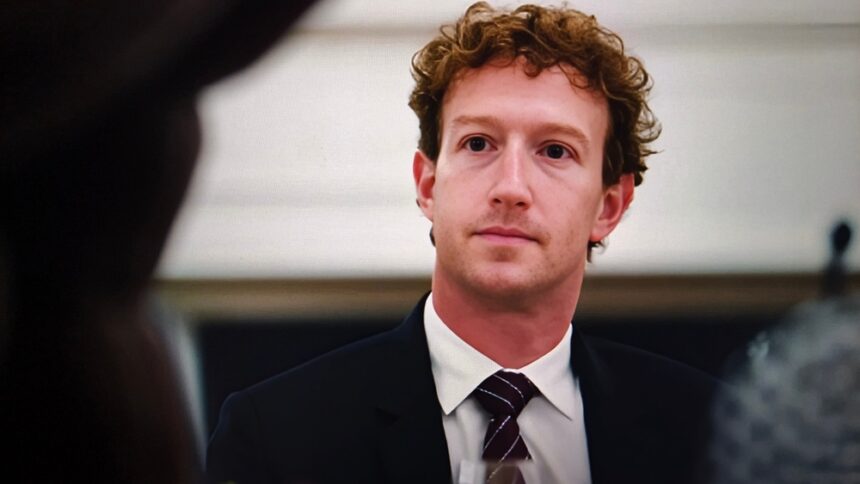
President Donald Trump appointed Meta CEO Mark Zuckerberg to the White House Council of Advisors on Science and Technology on Wednesday, adding one of Silicon Valley’s most powerful executives to a 13-person panel expected to shape the administration’s approach to artificial intelligence.
Zuckerberg expressed enthusiasm about the appointment, describing it as an opportunity for the United States to assert global leadership in AI development alongside other major industry figures. The council will be co-chaired by White House AI czar David Sacks and Office of Science and Technology Policy head Michael Kratsios.
Who else is on the council
The panel brings together a roster of technology executives with deep financial and political ties to the current administration. Nvidia CEO Jensen Huang and Oracle executive chairman Larry Ellison were also named to the council, along with Google co-founder Sergey Brin, Dell Technologies chairman and CEO Michael Dell, Oracle executive vice chair Safra Katz, and Andreessen Horowitz co-founder Marc Andreessen.
Ellison is a longtime Trump ally who personally guaranteed more than $40 billion in financing to help Paramount, whose chairman is his son David Ellison, acquire CNN’s parent company Warner Bros. Discovery. He is also part of the investor group that acquired a 15% stake in TikTok’s American operations in January as part of a White House-brokered agreement to keep the app running in the United States.
Huang has met regularly with Trump administration officials in an effort to roll back restrictions on the sale of Nvidia’s AI chips to China, an effort that has seen meaningful progress. Andreessen’s venture capital firm has been a significant force in shaping how congressional Republicans and the White House have approached AI legislation.
The composition of the council marks a departure from previous versions, which historically included a higher proportion of scientists and technical researchers with fewer direct political connections to the sitting president.
What the council is expected to do
The appointment comes shortly after the Trump administration released a legislative framework asking Congress to establish a uniform national AI policy that would override state-level regulations. Among the administration’s stated goals is preventing AI systems from being used to suppress lawful political expression, a priority that reflects Trump’s long-standing claims that major technology platforms have unfairly targeted conservative voices.
The council is positioned to influence how that framework takes shape and how aggressively the administration pursues federal AI legislation over the next several years.
A complicated day for Meta
The announcement arrived on a day that was otherwise difficult for Zuckerberg and his company. A jury found Meta and YouTube liable in a lawsuit brought by a young woman who argued that both platforms built deliberately addictive products that damaged her mental health. The jury determined that each company’s conduct was a meaningful contributing factor in the harm she experienced.
Separately, Meta confirmed Today that it had laid off hundreds of employees as part of an internal reorganization. The cuts were expected to continue beyond the initial round of notifications, and Zuckerberg had previously suggested the company planned to lean more heavily on artificial intelligence to handle functions that human workers currently perform.
How Zuckerberg got here
The relationship between Zuckerberg and Trump represents one of the more striking reversals in recent political history. Trump once described Facebook as an enemy of the American people and accused the platform of suppressing conservative content to benefit his political opponents. Zuckerberg has since donated $1 million to Trump’s inaugural fund, hired a former Trump administration official as Meta’s president, and made a series of policy changes widely interpreted as moves to align the company more closely with the administration’s priorities. Today’s council appointment is the most formal expression yet of how thoroughly that relationship has been rebuilt.