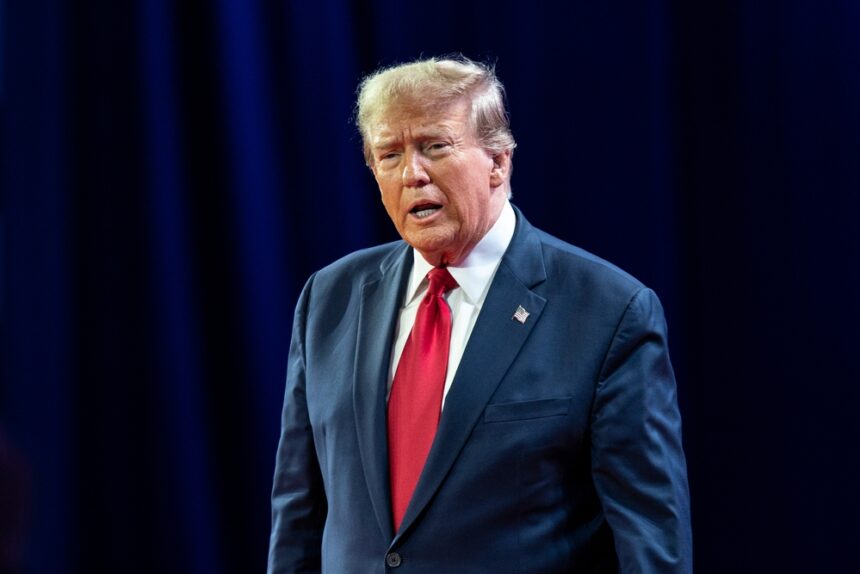
Gretchen Carlson, the former Fox News host who has become one of the more outspoken voices from the right flank of the media world, is raising concerns about what she believes is a deliberate and escalating pattern in Donald Trump’s use of religious imagery online. Speaking on CNN, she argued that the posts are not simply provocations designed to generate attention but something with a more calculated and potentially dangerous undercurrent.
The episode that set things in motion was Trump sharing an AI-generated image depicting himself as Jesus healing a sick man. The post drew immediate backlash from across the political spectrum, prompting Trump to delete it. His explanation afterward struck many as odd: he suggested he had thought the image simply made him look like a doctor. The comment did little to settle the controversy and, for many observers, raised more questions than it answered.
A follow-up post that raised the stakes
Rather than stepping back from the controversy, Trump leaned further into it. A second post appeared showing a Jesus-like figure embracing him, accompanied by a caption that framed any objection to the image as the work of radical opponents. The follow-up felt deliberate to Carlson, who read it as Trump adjusting his approach rather than abandoning the message. Instead of presenting himself as Jesus outright, the new imagery placed him in close and intimate proximity to the figure, suggesting an equivalence that stopped just short of direct identification.
Carlson described the implied message as one of spiritual closeness or equality, a framing that she found far more concerning than the initial image precisely because it was more subtle. She argued that the shift showed a level of intentionality that deserved serious scrutiny rather than dismissal as typical political noise.
Why Carlson finds it alarming
What troubled Carlson most was not any single post in isolation but the trajectory. She noted that just weeks before the images appeared, one of Trump’s own spiritual advisers had publicly compared him to Jesus during a public address, and the moment passed without any pushback from Trump or those around him. In her view, the silence was itself a signal, one that the religious imagery now appearing on his social media accounts was building upon.
She connected those moments to a broader dynamic she has observed among a segment of Trump’s most devoted supporters, a group that has at times framed their support in explicitly messianic terms. For Carlson, the posts feed directly into that narrative, and the fact that they keep coming suggests that the response, or lack of meaningful opposition to them, is being read as permission to continue.
A question with no easy answer
Carlson stopped short of predicting where the pattern leads but made clear she believes it is a question worth asking urgently. The concern she voiced was less about any single image and more about the normalization of a dynamic in which a sitting political figure is presented as divinely sanctioned or spiritually elevated above ordinary accountability.
For a former Fox News anchor who once occupied a very different place in the media landscape, the willingness to name that concern publicly is notable. Carlson’s critique lands not as partisan opposition but as something closer to a warning from someone who has watched how powerful narratives take hold and how difficult they become to dislodge once they do.