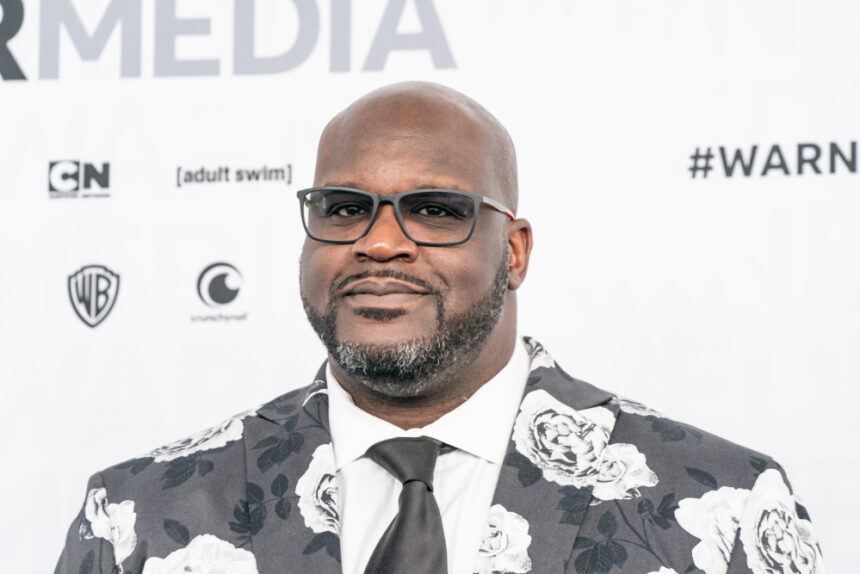
Shaquille O’Neal has spent most of his public life being enormous in every sense of the word. The physical presence, the personality, the career, the laughter. Very little about Shaq has ever been small or understated. But beneath all of that is a man shaped quietly and permanently by a single moment at a funeral, a moment that lasted no longer than half a minute and left a mark that has defined how he moves through the world ever since.
O’Neal has spoken at length over the years about the influence of his stepfather, Sergeant Phillip Harrison, a military man who raised him with discipline, structure and an unwavering standard of conduct. Harrison did not believe in softness, at least not publicly. In his household, men were expected to love, protect and provide. Emotion was not forbidden but it was managed, contained and never allowed to spill over into weakness.
That philosophy shaped Shaq from boyhood into one of the most dominant athletes the sport of basketball has ever produced. But it was one unguarded moment at his grandmother’s funeral that made it permanent.
30 seconds at the graveside
Harrison, for all his military rigidity, was at his core a mama’s boy. O’Neal has said so plainly and with obvious affection. So when Harrison’s mother passed away, Shaq expected his stepfather to finally crack. He prepared himself to be the strong one, to hold space for a man who had spent decades holding space for everyone else.
What happened instead was something O’Neal clearly still thinks about. Harrison grieved. He allowed himself that much. But the grief lasted exactly 30 seconds before the sergeant composed himself, straightened up and returned to the business of taking care of his family. When Shaq checked on him, Harrison explained simply that he had known this moment was coming, that grief was real but responsibility was immediate, and that there was simply no time to fall apart.
It was not a speech. It was not a lesson delivered with intention. It was just a man doing what he believed men were supposed to do. And it landed on Shaq like a blueprint.
A foundation built without a biological father
To understand why that moment hit so hard, it helps to understand where Shaq started. His biological father was absent during his early years, lost to addiction and unable to be the presence his family needed. That absence fell hardest on his mother Lucille, who raised Shaq with the help of her own mother and built a bond with her son that became one of the defining relationships of his life.
The closeness between Shaq and Lucille has been visible for decades, in pregame rituals, in interviews, in the way he has spoken about her publicly. It is the soft center inside the imposing exterior, the part of him that Harrison’s discipline never fully overrode.
Harrison entered that picture and provided something different. He was not gentle, by most accounts. The discipline was real and sometimes physical, the expectations were high and the tolerance for excuses was essentially zero. But he loved his family with the same intensity he demanded of them, and Shaq absorbed that too.
When the powers transferred
Harrison passed away in 2013. O’Neal has described that loss as a kind of transfer, as though the qualities his stepfather carried, the steadiness, the responsibility, the refusal to crumble, moved directly into him the moment Harrison was gone. He became, in his own words, the glue holding the family together.
That responsibility extends across a wide circle. Six children. An ex-wife he says he still feels accountable for. His mother. Siblings. The network of people who depend on him not just financially but emotionally, which means depending on him to remain upright when things fall apart.
He has admitted to crying only three times as an adult. When Harrison died. When his sister passed. And when Kobe Bryant was gone. Each time, the grief was real. Each time, the 30 second rule, whether followed precisely or not, guided him back.
Still the protector
At 54, O’Neal carries all of it with him. The fame has not changed the assignment. The money has not made the responsibility lighter. If anything, the years have deepened his understanding of what Harrison was trying to show him at that graveside, that strength is not the absence of feeling but the decision to keep moving in spite of it.
There is no time to cry. Or at least, not more than 30 seconds.