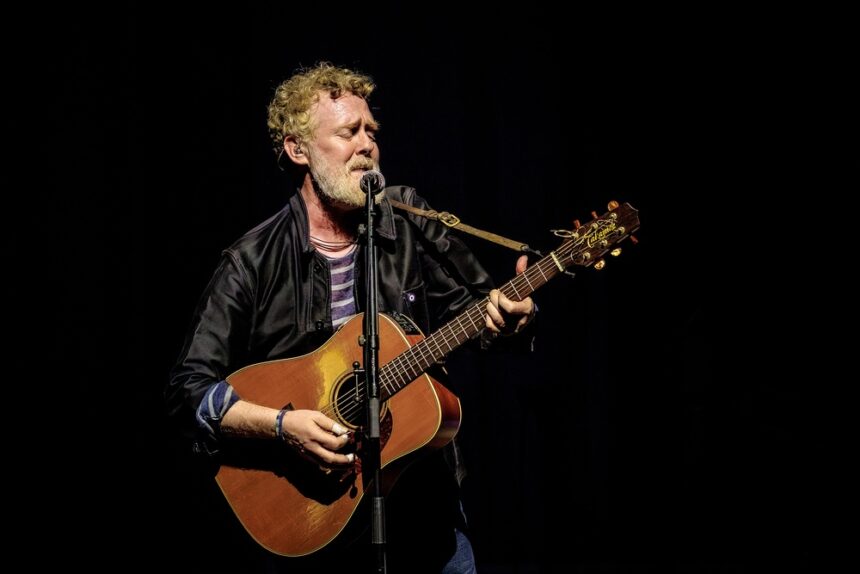
Glen Hansard, the Irish musician whose quiet brilliance as a performer and songwriter made him one of the most beloved figures in contemporary folk and rock music, died Wednesday following a motorcycle crash on the outskirts of Dublin. He was 56.
Hansard’s management company confirmed his death on behalf of his family, describing those closest to him as deeply shocked and heartbroken. The family asked for privacy as they begin to navigate the days ahead.
He was involved in a single-vehicle collision in the early hours of Wednesday morning. Emergency personnel responded to the scene and attended to Hansard, but he was pronounced dead shortly after. Authorities have opened an investigation into the circumstances of the crash, though it remains unclear what led to the incident.
He is survived by his wife, the Finnish poet Maire Saaritsa, whom he married in late 2022, and their young son, Christy.
A career that began on the street
Hansard was born in Dublin in 1970 and spent years as a teenager busking on Grafton Street before formal recognition of any kind arrived. That experience shaped the directness and emotional nakedness that became the hallmark of his performing style.
He first reached international audiences as a founding member of the Frames, the Dublin band he led for more than two decades. The group built a devoted following through relentless touring and a series of albums that grew more ambitious while retaining the raw emotional connection at Hansard’s core.
The music that changed everything came from a film. Once, the 2007 low-budget Irish musical directed by John Carney, starred Hansard alongside Czech musician Markéta Irglová as two struggling musicians in Dublin who connect briefly and deeply before going their separate ways. The film was made for under $160,000 and became a word-of-mouth phenomenon that spread far beyond what any of its creators had imagined.
An Academy Award that arrived on a film most had never heard of
The song Hansard and Irglová wrote for Once, titled Falling Slowly, won the Academy Award for Best Original Song at the 2008 ceremony. When Irglová was cut off during her brief acceptance speech by the orchestra, host Jon Stewart invited her back to the microphone, and her remarks about the power of music to reach people who feel isolated became one of the more remembered moments of that broadcast.
Hansard’s speech in those same moments captured something essential about who he was. He was clearly overwhelmed. He thanked his mother. He told people to make art. It did not look like a man who had planned for this.
The award opened doors he might not have otherwise walked through, and he used them for the same purposes he had always pursued. He released a series of solo albums that drew on Irish folk, Van Morrison’s soulful introspection, and the kind of gospel-inflected passion that transforms a concert into something approaching collective experience. He continued to tour almost constantly, particularly in the United States, where he built a loyal following that returned year after year to theaters and concert halls.
A performer who gave everything
Hansard was known among audiences and musicians alike for the completeness of his commitment in performance. He was not a reserved presence on stage. He played until his guitar strings bled, sometimes literally, and the intensity he brought to live performance was the subject of almost every piece ever written about him. He could silence a room with a whisper and bring it to its feet without needing a signal.
That quality came through in the work he did beyond his own recordings. He was a deeply collaborative musician who appeared on records and stages alongside artists from multiple traditions, and he was considered by many to be one of the most generous musicians of his generation in how he shared his gifts and his time.
Ireland, which mourns its musical figures with a particular depth, had long claimed him as one of its own. The world outside it had agreed. He was 56, and he was in the middle of what felt, even from a distance, like the most fully realized chapter of his work.