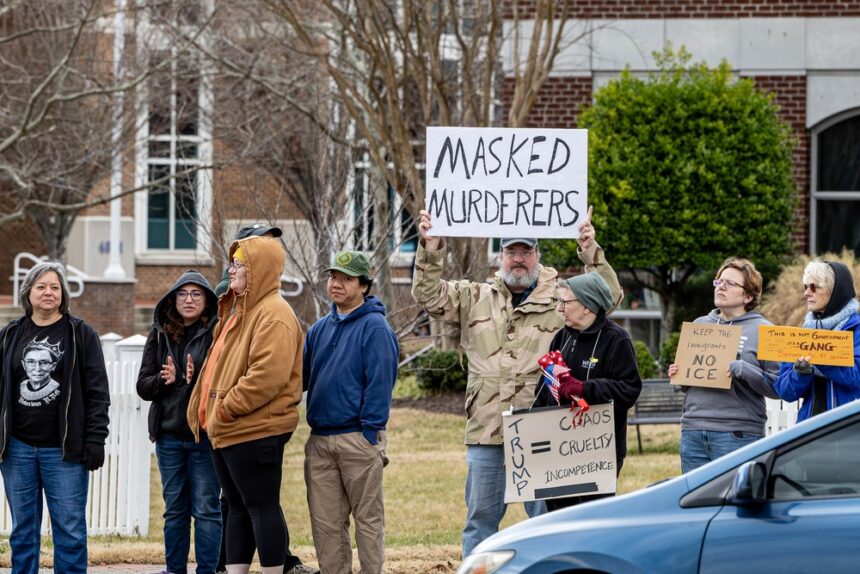
A United States district judge ruled on June 30 that a Virginia law prohibiting federal immigration agents from wearing masks while conducting enforcement operations is likely unconstitutional, blocking the legislation from taking effect just one day before it was scheduled to become law.
The judge issued a preliminary injunction against the measure, finding that the state statute directly regulates the conduct of federal law enforcement in the execution of federal immigration law in a manner that conflicts with the Constitution’s supremacy clause. That clause establishes federal law as the supreme law of the land and has been interpreted by courts over many decades to prevent states from legislating in ways that would impede the federal government’s exercise of its constitutional authority.
The legal reasoning behind the ruling
The judge’s three-page decision identified two distinct grounds for finding the law likely unconstitutional. The first was the structural constitutional argument, that a state cannot regulate how federal agents conduct themselves when enforcing federal law without running into the supremacy clause’s prohibition on state interference with federal authority.
The second ground was more immediately practical. The judge found that allowing the law to take effect would expose federal employees to a genuine risk of physical harm when carrying out immigration enforcement operations. That finding reflected testimony or evidence presented to the court suggesting that requiring agents to reveal their identities in the field creates conditions that make them vulnerable to retaliation or targeted violence.
Together, those findings satisfied the legal standard required for a preliminary injunction, which asks a court to determine whether the party seeking relief is likely to succeed on the merits of the case, whether they would suffer irreparable harm without relief, and whether the balance of equities favors granting the injunction.
The broader constitutional principle at stake
The supremacy clause dispute between Virginia and the federal government reflects a tension that has produced litigation across multiple areas of law wherever state and federal authority overlap. Immigration has been among the most contested of those domains, with federal courts consistently finding that the regulation of immigration enforcement is fundamentally a federal function that states cannot impede through their own legislation.
Virginia’s law had been framed as a safety and accountability measure, with the state legislature presumably arguing that individuals interacting with law enforcement have an interest in knowing the identity of the agents they are dealing with. Federal officials and the administration argued the opposite, that agent anonymity serves critical safety and operational security purposes in immigration enforcement contexts.
The judge’s ruling does not permanently resolve the question of the law’s constitutionality. A preliminary injunction holds the law in suspension while litigation continues, and the state retains the ability to argue its case fully at trial. However, the court’s finding that the federal government is likely to succeed on the merits sets up a difficult path for Virginia to ultimately prevail.
What comes next
The preliminary injunction will remain in place while the underlying case moves forward through the federal courts. If the state appeals the injunction, a higher court will have the opportunity to review whether the district judge applied the correct legal standard and reached the appropriate conclusion on the supremacy clause question.
The ruling fits within a larger pattern of federal courts blocking state laws that attempt to regulate immigration enforcement practices, an area where the balance of constitutional authority has consistently favored the federal government regardless of which party holds the White House.