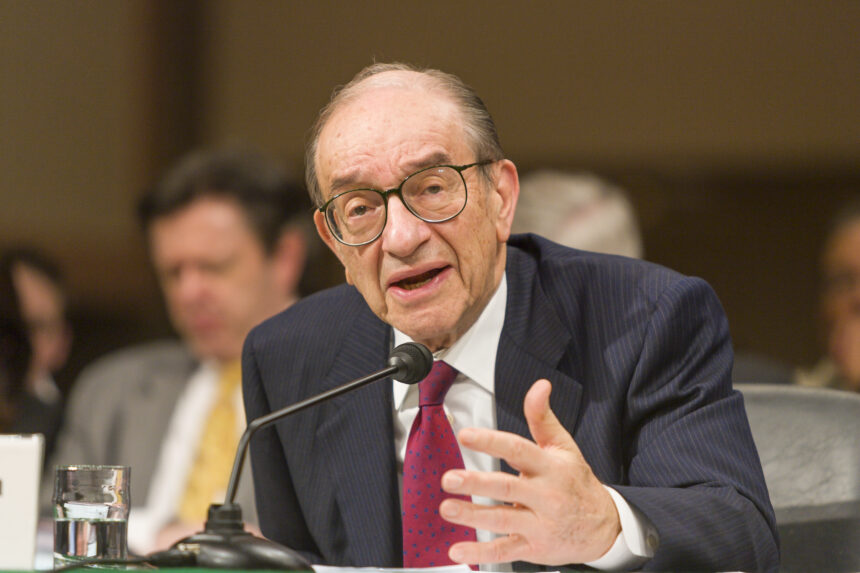
Alan Greenspan, the former chairman of the Federal Reserve who guided the United States central bank through nearly two decades of economic expansions, market crises, and policy decisions that shaped the financial lives of millions of Americans, died on June 22 at the age of 100. His passing was attributed to complications from Parkinson’s disease.
Greenspan served as Federal Reserve chairman from 1987 to 2006, an 19-year tenure that spanned the administrations of four presidents from both political parties. His longevity in the role, combined with the range of economic conditions he navigated, made him one of the most consequential figures in the history of American monetary policy. During his tenure he oversaw periods of robust growth, managed the aftermath of significant financial shocks, and became one of the most closely watched public figures in economic life, with markets and politicians parsing his carefully calibrated language for signals about the direction of interest rates.
A career that defined modern central banking
Greenspan’s influence extended well beyond the technical decisions of the Federal Reserve’s Open Market Committee. He helped define what it meant for a central bank to operate with independence from political pressure while remaining accountable to the public, and his approach to communication, at once guarded and authoritative, set a tone that shaped how central bankers worldwide thought about their public role.
He was not without controversy. In the years following his tenure, critics argued that monetary policy decisions made during his chairmanship contributed to the conditions that produced the 2008 financial crisis, and Greenspan himself acknowledged publicly in the years that followed that his confidence in certain market mechanisms had been misplaced. That willingness to revisit his own assumptions distinguished him from many figures who hold power for extended periods.
The Federal Reserve acknowledged his death with a formal statement honoring his contributions to monetary policy and the broader field of economics, noting that he had guided the institution through various expansions and periods of considerable stress.
A personal life alongside public greatness
Greenspan’s death was announced by his wife, NBC News journalist Andrea Mitchell, who met him in 1984 and married him in 1997. Her statement described a man whose public stature was matched by warmth and genuine intellectual enthusiasm in private life. She spoke of his passion for baseball, tennis, golf, music, and a particular love of jazz, painting a portrait of someone whose interests extended well beyond the corridors of monetary policy.
Mitchell described herself as having been shaped by her decades alongside him and called being his partner the defining joy of her life. Her words captured the private dimension of a man who had spent most of his public years in the somewhat antiseptic world of economic policy, where personal warmth is rarely the central attribute on display.
A legacy still being measured
Greenspan’s impact on American economic life remains a subject of genuine debate among economists and historians. His supporters credit him with helping to manage a long period of economic expansion and with navigating the central bank through shocks that might have produced far worse outcomes without steady leadership. His critics point to monetary policy choices that they believe contributed to bubbles and eventually to the broader conditions that produced the financial crisis that arrived just after his departure.
That complexity is itself a mark of consequence. Figures whose legacies are simple and uncomplicated rarely shaped anything of lasting importance. Alan Greenspan shaped the American economy for nineteen years. He was 100.