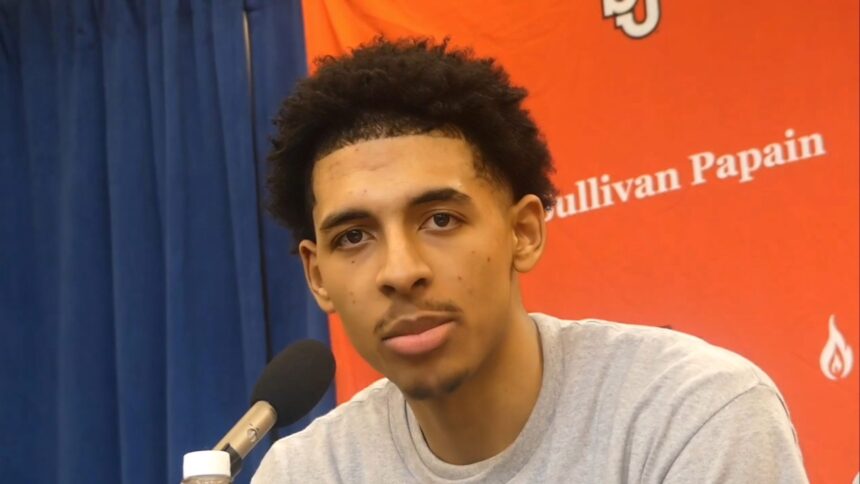
RJ Luis Jr. made one of the more dramatic commitments of the 2026 offseason, pledging to LSU after a professional career that ended almost before it began. The former St. John’s standout arrives in Baton Rouge carrying Big East Player of the Year hardware, consensus second-team All-American recognition and a resume that would make him one of the most talented players on any college roster in the country — if he is ever allowed to step on the court.
That last part is the problem nobody in Baton Rouge wants to talk about yet.
A Career Built at St. John’s
Luis spent two seasons with the Red Storm after transferring from UMass following his freshman year. His junior campaign in 2024-25 was the one that cemented his reputation nationally — 18.2 points and 7.2 rebounds per game across 35 games, a No. 2 NCAA Tournament seed and a Big East Player of the Year award earned in one of the toughest conferences in the country. For a 6-foot-7 wing playing that level of competition, those numbers placed Luis firmly among college basketball’s elite performers.
BREAKING: Former pro guard RJ Luis Jr. has signed with LSU, @PeteNakos reports🐯
Luis was the 2025 Big East player of the year.https://t.co/mzMe9luCgH pic.twitter.com/ZdUDJKoec3
— On3 (@On3) May 19, 2026
The NBA Dream and the Injury That Ended It
Luis declared for the 2025 NBA Draft and went undrafted. He signed a two-way deal with the Utah Jazz before being traded to the Boston Celtics in a package that included forward Georges Niang. Boston signed Luis to an Exhibit 10 contract, but a groin injury requiring surgery ended his professional path before the season even started. He never appeared in a single G-League game.
The Luis Eligibility Problem
Luis is not currently eligible to compete at the college level, and the road back is anything but straightforward. NCAA President Charlie Baker has publicly stated that athletes who previously signed professional contracts — including two-way deals — remain ineligible under existing rules. Luis falls squarely in that category, and his path back is expected to involve legal action.
The precedent is not encouraging. Former Alabama center Charles Bediako returned to college basketball this past season after years in the G-League, initially receiving eligibility through the courts and appearing in five games before a subsequent ruling stripped that eligibility away. James Nnaji, selected in the 2023 NBA Draft who later played overseas, managed 18 games for Baylor this season after his own legal challenge. Neither case resolved cleanly, and Luis’s situation carries at least as much complexity.
The NCAA‘s Board of Directors is currently weighing a rule change that would establish a five-year eligibility window tied to high school graduation or a player’s 19th birthday. The proposed change is not expected to apply retroactively, meaning it would not resolve Luis’s case on its own terms.
What LSU Actually Gains
If Luis is cleared to play, Will Wade’s roster immediately becomes one of the most ambitious in the country. Luis would be the seventh addition of LSU’s offseason, joining Abdi Bashir Jr. from Kansas State, Divine Ugochukwu from Michigan State, Austin Nunez from UTSA, Mouhamed Dioubate from Kentucky and Alabama, Brazilian forward Marcio Santos and Israeli guard Yam Madar. LSU currently has just five players confirmed on the roster for next season, with international additions still expected as the offseason continues.
RJ Luis Jr. is the highest-profile name in that group by a significant margin. But his ability to suit up for the Tigers depends entirely on legal and regulatory developments that remain far from resolved. Wade is building something real in Baton Rouge — the question is whether its most important piece will ever be available to use.