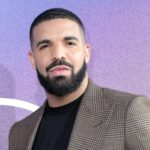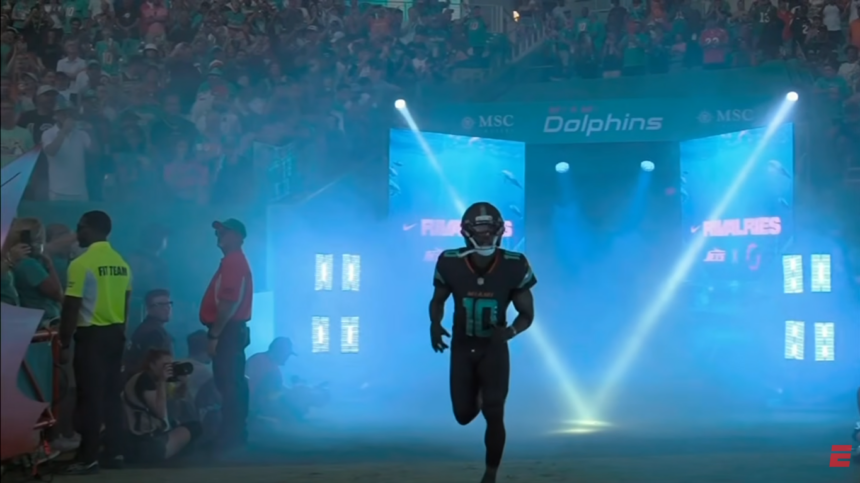
The Cheetah is free for the first time in his career, saying he’s “born again” while the Dolphins shed $23 million in cap space
The Miami Dolphins released Tyreek Hill on Monday, ending a relationship that never quite lived up to the massive investment the team made to acquire him. The former star receiver dislocated his knee and tore his ACL in Week 4 of the 2025 season and missed the rest of the year. He’s 32 now, about to turn 32 in March, and is a free agent for the first time in his 10-year NFL career. The Dolphins also released linebacker Bradley Chubb and offensive lineman James Daniels, clearing roughly $23 million in cap space (potentially $30 million if Chubb’s release is immediate). This isn’t just roster management. This is the Dolphins finally admitting that their two biggest free agent bets didn’t work out.
- The Cheetah is free for the first time in his career, saying he’s “born again” while the Dolphins shed $23 million in cap space
- Bradley Chubb’s story is almost identical: massive trade, huge extension, never quite delivered
- Hill’s Instagram response was philosophical: “The Cheetah don’t slow down. Ever”
The Dolphins traded an absolutely massive package to get Hill in 2022: a first-round pick, second-round pick, two fourth-round picks, and a sixth-round pick. Then they signed him to a four-year, $120 million extension. He was supposed to be the centerpiece of their offense. For one season, he was. Hill posted consecutive 1,700-yard seasons in 2022 and 2023, making him the most productive receiver in the NFL. Then it all fell apart. His production “tapered off” in 2024 (81 catches, 959 yards, six touchdowns), and an injury in Week 4 ended what was left of the relationship.
What makes this harder is that Hill’s four seasons in Miami were plagued by off-field issues. Multiple lawsuits, an incident in 2024 when Miami-Dade police officers dragged him out of his vehicle outside Hard Rock Stadium just hours before the Dolphins’ regular-season opener. This wasn’t just an injury situation. This was an entire Miami experiment that never stabilized. The Dolphins paid enormous capital and money for a player who couldn’t stay healthy or avoid controversy.
Bradley Chubb’s story is almost identical: massive trade, huge extension, never quite delivered
The Dolphins traded a first-round pick to Denver for Chubb and signed him to a five-year, $110 million extension. He had a double-digit-sack season in 2023 (11 sacks), then suffered a significant knee injury including a torn ACL, meniscus, and patellar tendon. He missed the entire 2024 season. He returned in 2025 with 8.5 sacks in all 17 games and was a team captain who won the local media’s “Good Guy” award. Yet his pressure rate was the third highest of his career, but his pass rush win rate (7.8%) was career-low because he was being double-teamed at a career-high 23.1% rate. At 30 years old, with torn ACLs in both knees, and representing a $31 million cap hit, releasing him makes financial sense. It doesn’t make moral sense, but it makes financial sense.
Hill’s Instagram response was philosophical: “The Cheetah don’t slow down. Ever”
He thanked the Dolphins, his teammates, and the fans. He vowed his career isn’t over. “Every chapter in life has taught me something. This one taught me leadership, resilience, and mostly gratitude.” Whether that’s genuine peace with the situation or coded language for frustration depends on who you ask. But “The Cheetah is all the way turned up and locked in” suggests Hill believes there’s still football left in him.
What’s notable is that the Dolphins haven’t made a decision about Tua Tagovailoa yet, despite benching him at the end of last season after 15 interceptions. Tua represents a $56 million cap hit in 2026 with $54 million guaranteed. The Dolphins signed him to a four-year, $212.1 million extension in 2024. New GM Jon-Eric Sullivan says the team will “look to add competition” at quarterback while “prioritizing team-building.” Translation: they’re rebuilding, and Tua might be part of that rebuild or he might not.
This is what happens when massive trades and huge contracts don’t work out. Eventually, the Dolphins cut their losses and move on.