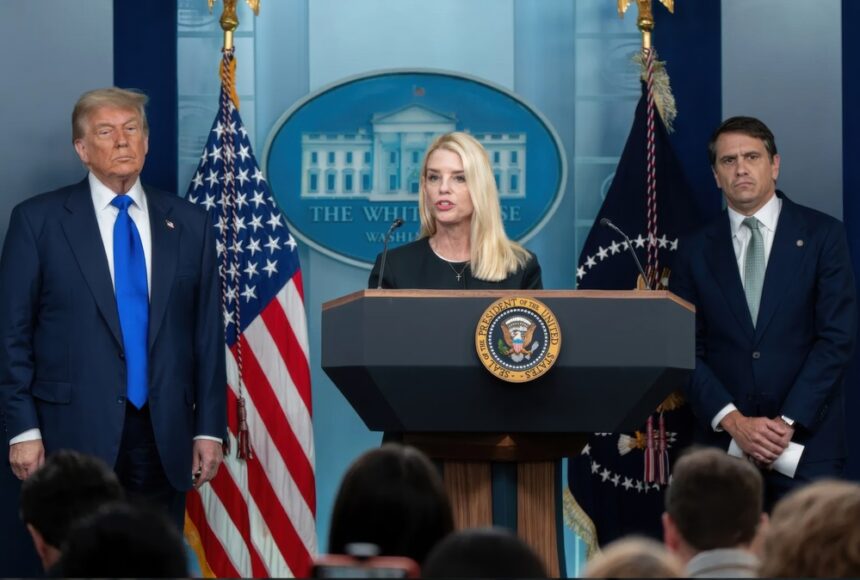
President Trump said on Aug. 10 that whether to revive the rescinded $1.8 billion anti-weaponization program will be a decision for newly confirmed Attorney General Todd Blanche, declining to elaborate on whether the administration is actively considering restoring it.
Trump made the remark to reporters in the Oval Office during a press conference, responding to a question about whether the administration had options under consideration to revive it. He pointed to Blanche as the appropriate decision-maker, describing him as someone he expects will be a great attorney general.
Blanche was confirmed by the Senate in a 50-49 vote on Aug. 8 and was sworn in on Aug. 10, the same day Trump made his comments. Two Republican senators, Susan Collins of Maine and Lisa Murkowski of Alaska, voted against his confirmation.
Background on the rescinded fund
The anti-weaponization arrangement was created as part of a settlement in Trump’s lawsuit against the IRS over alleged unauthorized leaks of his tax returns. It was intended to compensate individuals who claimed they had been targeted by what the administration characterized as politically motivated legal actions under the previous administration.
Blanche, while still serving in an acting capacity, formally rescinded the anti-weaponization program on Aug. 2. The decision came after Republican senators including John Cornyn and Thom Tillis said they had concerns that could affect their votes on his confirmation. With the program rescinded and those concerns addressed, his confirmation proceeded.
A federal court had separately reviewed the fund and found the arrangement to be collusive and improper, a finding that added judicial weight to the congressional concerns.
What Trump’s comment leaves open
Trump’s brief answer pointed to Blanche without indicating whether the fund’s revival is something the White House is pursuing or whether the comment was simply an acknowledgment that the attorney general would have authority over decisions in that domain. The lack of elaboration leaves the question genuinely open.
Reviving a program that a federal court found improper and that was rescinded under congressional pressure would present significant practical and legal challenges. Any reconstituted version would likely face immediate scrutiny from the same senators whose opposition triggered the initial rescission and from courts that would have the earlier judicial finding as precedent.
Whether Blanche, now confirmed and sworn in, has any interest in revisiting a program he himself chose to rescind is unknown. His public positioning through the confirmation process was that the rescission was the appropriate action.
The attorney general’s position
Blanche arrives in his new role having personally signed the order that rescinded the arrangement, which makes the question of whether he would revive it an interesting test of how he will exercise independent judgment as a confirmed cabinet officer versus how he operated as an acting official still seeking confirmation.
Cabinet officials who act to please a Senate audience during confirmation sometimes shift their positions once they no longer require votes. Whether Blanche’s rescission of the anti-weaponization program was a genuine policy conviction or a tactical concession made to clear his path to confirmation is something his actions in coming months may clarify.
Trump‘s Aug. 10 comment, brief and without commitment, suggests he has not given up on the fund concept even if the timing and mechanism for any revival remain undefined.