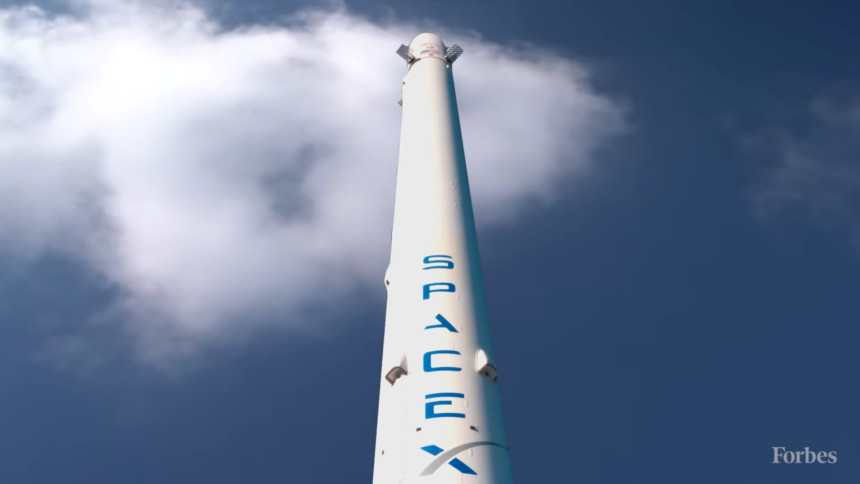
SpaceX’s Falcon Heavy lifted off from Launch Complex 39A at NASA’s Kennedy Space Center in Florida on Wednesday morning at 10:13 a.m. EDT, ending an 18-month absence from the launchpad with a mission that could eventually change what it means to use Wi-Fi on an airplane.
The payload was ViaSat-3 F3, a 6.6-ton communications satellite and the third and final piece of the ViaSat-3 broadband constellation. The rocket carried the spacecraft toward geosynchronous transfer orbit, with deployment expected roughly five hours after liftoff. Weather had scrubbed Monday’s attempt, but forecasters gave Wednesday a 90% chance of favorable conditions, and the rocket delivered.
What Falcon Heavy is and why the launch mattered
Falcon Heavy is built from three modified versions of SpaceX’s Falcon 9 first stage strapped together, generating approximately 5.1 million pounds of thrust at liftoff. That puts it behind only NASA’s Space Launch System, which produces 8.8 million pounds of thrust, among rockets currently in active operation. SpaceX’s Starship surpasses both at 16.7 million pounds of thrust, but remains in development.
Wednesday marked the rocket’s 12th flight. It debuted in February 2018 carrying SpaceX founder Elon Musk’s cherry-red Tesla Roadster into solar orbit, and has not recorded a failed mission since. Its most recent prior launch, in October 2024, sent NASA’s Europa Clipper spacecraft on its journey toward the Jupiter system.
Two of Falcon Heavy’s missions have now carried ViaSat-3 satellites. The first, ViaSat-3 F1, launched aboard the rocket in April 2023. ViaSat-3 F2 followed in November 2025 on a United Launch Alliance Atlas V.
Falcon Heavy side boosters land as the core stage makes its exit
About eight minutes after liftoff, both of Falcon Heavy’s side boosters returned to earth simultaneously, touching down at SpaceX’s landing zones at Cape Canaveral Space Force Station. Booster 1072 completed its second flight. Booster 1075, a well-traveled piece of hardware, landed for the 22nd time. The mission’s brand-new central core stage, designated B1098, was not recovered and came down in the Atlantic Ocean, consistent with the mission’s flight profile.
ViaSat-3 F3 and what it means for passengers in the air
ViaSat-3 F3 will operate in geostationary orbit at 158.55 degrees East along the equator, positioning it to provide high-throughput broadband service across the Asia-Pacific region. At geostationary altitude, roughly 22,236 miles above Earth, a satellite’s orbital velocity matches the planet’s rotation, allowing it to remain fixed over the same geographic area continuously.
Dave Abrahamian, Viasat’s vice president of satellite systems, has described the practical implications for airline passengers in tangible terms. As the satellite enters service, he said, more airline customers are expected to offer free in-flight Wi-Fi, and the network’s capacity has grown to the point where passengers can stream video at 4K resolution mid-flight. That is a significant distance from where in-flight connectivity began, when basic messaging was considered a meaningful feature.
Orbit-raising to the satellite’s final operating position will take approximately two months. After that, several additional months of deployment stages and system checkouts are required before Boeing, which built the spacecraft, hands it over to Viasat for operational use.
ViaSat-3 F1 is already serving airline customers. ViaSat-3 F2 is expected to come online next month, providing coverage for customers in the Americas. F3 completes the trio, extending the network’s reach across Asia and the Pacific.
Falcon Heavy was originally scheduled to carry the satellite on Monday, April 27, but weather forced the delay. Wednesday’s launch came off without incident, giving SpaceX another clean entry in a flight record that has remained unbroken across all 12 Falcon Heavy missions.