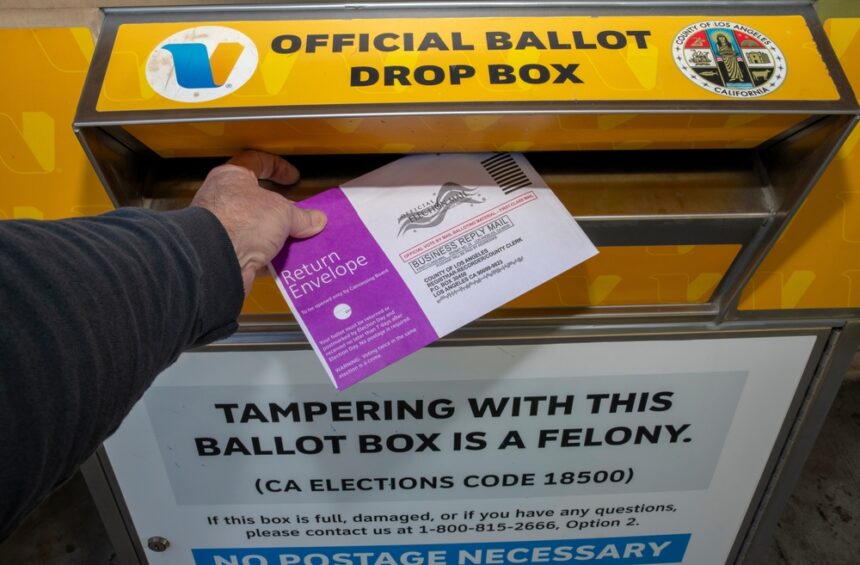
The California Supreme Court ruled unanimously on Sept. 24 that a county sheriff illegally seized more than half a million voted ballots from last year’s special election, and ordered them returned to the county’s elections office immediately.
What exactly was seized?
Roughly 650,000 voted ballots in around 1,000 boxes, taken earlier this year under search warrants the Riverside County sheriff obtained after opening a criminal investigation into the election. The Riverside ballot seizure covered ballots cast in the Nov. 4, 2025, special election at which voters approved Proposition 50, authorising a legislature drawn congressional map for 2026 through 2030.
What prompted the investigation?
A complaint from a local group that compared handwritten precinct intake logs against the certified count and alleged a discrepancy of 45,896 votes. The sheriff treated that allegation as a criminal matter.
Was the discrepancy real?
Not at anything approaching that scale. The county registrar of voters said the group had misinterpreted ballot data and that the actual gap was 103. The difference between the two figures is not a matter of interpretation. One is a claim of tens of thousands of unaccounted ballots and the other is a rounding level variance in an election involving hundreds of thousands of votes.
What did the court actually decide?
That the seizure was unlawful, and nothing about whether the election was sound. This distinction matters. The ruling addresses a sheriff’s authority to take custody of voted ballots, not the accuracy of the count. In a companion case, the court also held that the sheriff must comply with the state attorney general’s order pausing his criminal investigation.
Why does custody of ballots matter so much?
Chain of custody is the foundation of every post election check. Voted ballots are held by election officials under specific statutory procedures precisely so that audits and recounts can be performed against records whose handling is documented. Removing 650,000 ballots into law enforcement custody disrupts that chain regardless of intent, which is part of why the legal framework limits who may hold them.
What is the argument the sheriff made?
That a credible allegation of a large discrepancy warranted criminal investigation, and that investigating requires access to evidence. Supporters of the Riverside ballot seizure argued a law enforcement officer receiving a complaint of that magnitude could not simply decline to act. The court’s response concerned authority rather than motive, finding that the method was not available to him whatever the complaint alleged.
Is there a political dimension?
Unavoidably. The sheriff ran as a Republican in this year’s gubernatorial primary and lost in June. The election under investigation approved a congressional map favourable to Democrats. Neither fact establishes anything about his reasoning, and both are context readers are entitled to have.
What happens next?
The ballots return to the registrar and the criminal investigation stays paused. Whether any further consequence follows for the sheriff’s office is a separate question the ruling does not address.