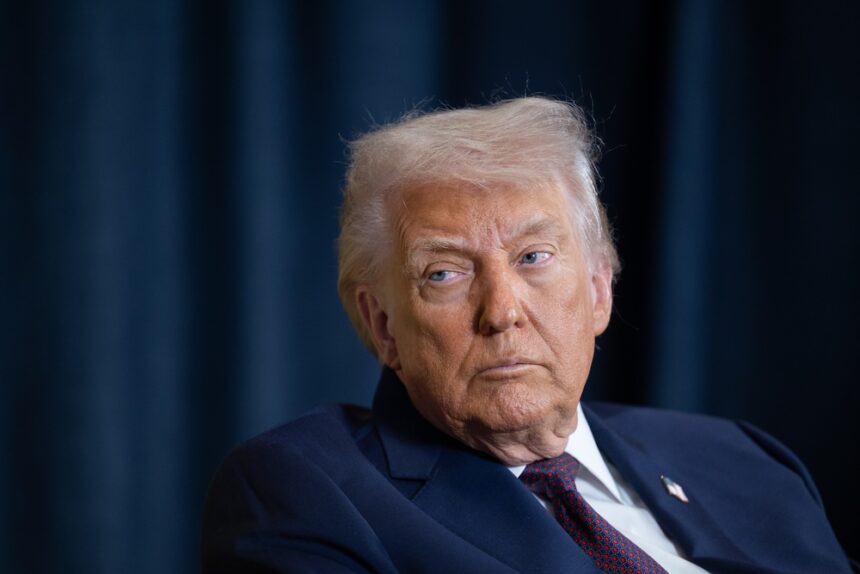
President Donald Trump said Thursday that he believes the war with Iran will end soon and expressed confidence that an agreement to reopen the Strait of Hormuz is within reach, while also acknowledging that some U.S. military munitions stockpiles are running tighter than others.
Trump made the remarks to reporters in the Oval Office on Aug. 6 when asked about the state of American weapons inventories and his assessment of the conflict, which has now extended into its sixth month. He said he believes Iran cannot continue much longer, and when asked specifically about the Strait of Hormuz, he said he thinks the country is doing very well and that he is personally involved in the negotiation.
The Strait of Hormuz is the critical maritime chokepoint at the mouth of the Persian Gulf through which a substantial portion of the world’s oil and gas passes. Iranian forces have targeted commercial ships in the waterway with fast boats, drones and missiles, disrupting traffic and driving up energy costs globally.
The disconnect on talks
Trump’s characterization of his involvement in negotiations over the strait stands in contrast to what Iranian officials have said publicly. Iran has said that direct talks over reopening Hormuz are taking place with Oman as an intermediary and do not include the United States as a participant. Iranian officials have, however, acknowledged that other regional actors such as Qatar are involved in background communications, passing messages between Washington and Tehran.
The competing accounts reflect a diplomatic situation in which multiple channels are operating simultaneously and neither side has a clear interest in publicly acknowledging every form of contact. Direct talks that one party acknowledges and another denies are a common feature of high-stakes negotiations in which domestic political constraints on both sides make full transparency difficult.
What Trump said about weapons stockpiles
Trump’s acknowledgment that some weapons stockpiles are tighter than others while others are in virtually unlimited supply is an unusually candid public assessment of American military inventory during an active conflict. Presidents and military officials typically avoid discussing the state of munitions stocks in detail during hostilities, both to avoid signaling vulnerabilities to adversaries and to manage domestic expectations.
The six-month duration of the conflict has been sufficient to draw down some categories of precision munitions that the U.S. military uses in large quantities during sustained operations. Replenishment of those stockpiles depends on production capacity at defense contractors, which has been a subject of concern in broader discussions about American military readiness following significant weapons transfers to Ukraine since 2022.
The broader conflict context
Trump’s statement that he believes Iran cannot continue much longer reflects the administration’s position that sustained military and economic pressure is working. Iran’s economy has been under severe sanctions pressure for years, and the additional costs of the current conflict have compounded those pressures.
Iranian officials have publicly projected a different assessment, saying the country is prepared to continue indefinitely and that any resolution requires the United States to meet specific conditions regarding sanctions relief and security guarantees.
The gap between the two sides’ stated positions on how long the conflict can last and on what terms it might end is significant, and Trump’s expressions of confidence that a deal is near have been offered before without producing an agreement. Whether the current moment represents genuine progress toward a resolution or continued posturing by both sides cannot be determined from public statements alone.
The coming weeks will either produce the agreement Trump is projecting or offer evidence that the conflict’s resolution remains further away than his Oval Office comments suggest.