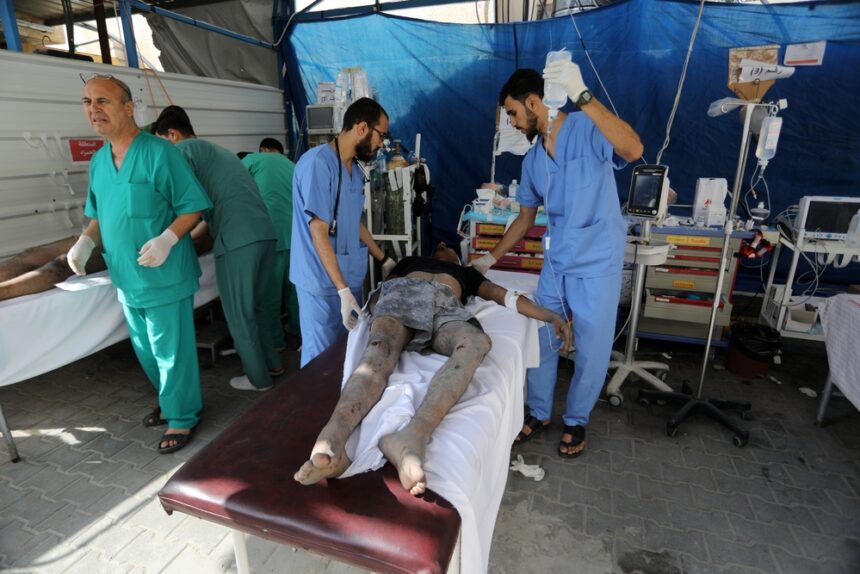
Israeli military operations in Gaza continued on Aug. 1 with airstrikes that Palestinian health officials said killed at least 18 people, just days after a U.S.-backed agreement was announced regarding Hamas disarmament. Israeli officials said the operations would not stop until Hamas fully disarms.
Palestinian authorities said Israeli strikes targeted medicine warehouses at Al-Aqsa Martyrs Hospital in Deir al-Balah during the Aug. 1 operations. The Hamas-run Gaza Health Ministry said two of the hospital’s four medicine warehouses were entirely destroyed, with the remaining two suffering severe damage. The ministry said the strikes also damaged the hospital’s outpatient clinic and destroyed medical supplies that had been intended for patients and those wounded in the conflict.
The statements came from the Hamas-run health ministry, and neither the reported death toll nor the ministry’s account of the hospital strike could be independently verified.
Calls for protection of medical facilities
The Gaza Health Ministry issued a call for the international community, United Nations agencies and humanitarian organizations to intervene to protect medical facilities and healthcare workers in the territory. Such calls have become a recurring element of the conflict, as hospitals and medical infrastructure have repeatedly been reported damaged or destroyed. Israel has disputed accounts of such targeting in various prior incidents, asserting that some sites have been used for military purposes by Hamas.
The international legal framework governing armed conflict prohibits attacks on hospitals and medical personnel, with limited exceptions when those facilities are being used for military purposes that go beyond their humanitarian function. Allegations of such violations require investigation and verification, and the competing claims about specific incidents in Gaza have been a persistent feature of the conflict’s information environment.
The broader context of the conflict
The continuation of operations despite the announced disarmament agreement reflects the complexity of the moment. A disarmament framework, however supported by outside parties, does not produce an immediate ceasefire unless both combatants agree to lay down weapons. Israeli officials made clear that military pressure would continue until Hamas actually implements full disarmament rather than agreeing to it in principle.
Hamas has governed the Gaza Strip since taking control of the territory in 2007. The group is designated a terrorist organization by the United States, the European Union, Israel and other countries. The disarmament agreement announced in the days before the Aug. 1 strikes had not been fully detailed publicly in its terms, implementation timeline or verification mechanisms at the time of the attacks.
The gap between a diplomatic announcement and actual implementation has repeatedly produced moments of continued violence in Gaza, as both the military pressure and the political negotiations proceed on separate tracks.
Humanitarian conditions in Gaza
The reported destruction of medicine warehouses at a hospital in Deir al-Balah adds to a humanitarian picture that has been severely deteriorating throughout the conflict. Medical supplies, food, clean water and shelter have all been subject to significant constraints in Gaza, and the destruction of any hospital infrastructure has cascading effects on the territory’s capacity to treat wounded civilians.
International aid organizations have repeatedly called for increased access to deliver supplies and for protections to allow medical facilities to function. The United Nations and affiliated agencies have documented extensive damage to Gaza’s healthcare infrastructure across the duration of the conflict. The territory had a limited healthcare system even before the current hostilities, and the conditions reported as of Aug. 1 represented a significant degradation of what remained.
The situation continues to evolve rapidly, and casualty figures and infrastructure assessments from active conflict zones should be treated with appropriate caution pending independent verification.