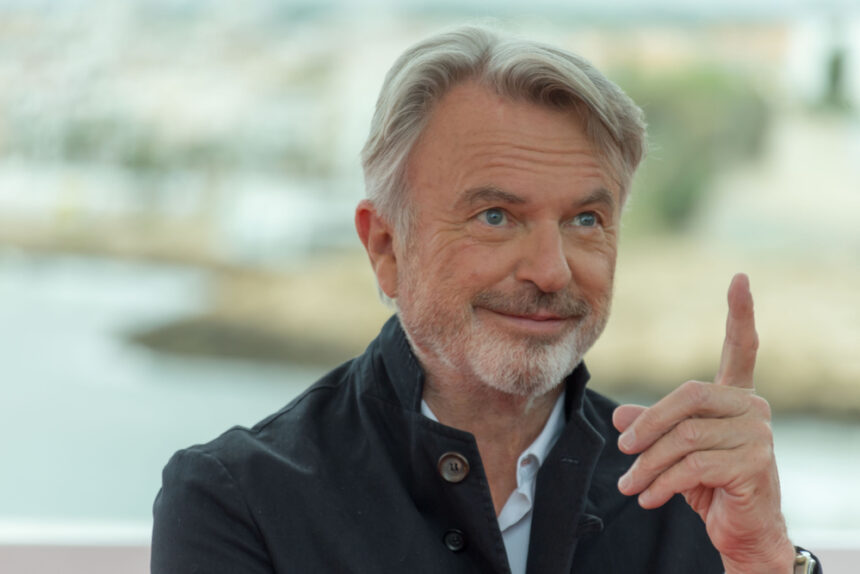
Sam Neill, the New Zealand-born actor whose five-decade career took him from Antipodean stages to the center of some of Hollywood’s most enduring films, died suddenly on July 13 in Sydney, Australia, his family announced, saying he was surrounded by loved ones and that the loss was unexpected despite his having remained cancer-free following a serious blood cancer diagnosis three years earlier.
The family’s statement described his passing as characterized by the dignity that had defined his life and noted that he was free of the stage 3 angioimmunoblastic T-cell lymphoma, a rare form of blood cancer, that he had publicly disclosed in early 2022. The cause of death had not been released at the time of the announcement.
A career of remarkable range
Neill built one of the most distinguished bodies of work of any New Zealand performer, moving across genres and formats with a facility that made him as comfortable in global blockbusters as in quiet character-driven independent films, British television dramas, and productions from his home country. His dry wit, understated intelligence, and an apparent ease in front of the camera that concealed considerable technique made him a reliable and often irreplaceable presence across more than five decades of work.
He is perhaps most widely recognized internationally for his role in Jurassic Park, the Steven Spielberg film that became one of the most commercially successful of the 1990s and introduced him to a generation of audiences who may have known him only from that context. But his career extended in many directions before and after that film, and his range across that full body of work is what defined him as a serious actor rather than simply a box office name.
Among his other significant credits were roles in historical epics, psychological thrillers, and award-winning prestige productions. He brought the same commitment and specificity to a broad spectrum of material, and the directors who worked with him repeatedly noted that he was capable of finding interior life in roles that lesser performers might have delivered on the surface only.
His cancer disclosure and recovery
Neill revealed his lymphoma diagnosis publicly in 2022, becoming one of the more prominent figures to speak openly about the experience of a serious cancer diagnosis and the treatment process. He described the period with characteristic candor and even humor, and his public engagement with the subject contributed to broader conversations about blood cancers and the importance of early detection and treatment.
His family’s confirmation that he remained cancer-free at the time of his death separates his passing from the illness that had most recently threatened his life, making the suddenness of the loss particularly difficult for those close to him to process. He had spoken in the period following his treatment with evident satisfaction about having returned to work and to the full life he valued.
What he leaves behind
Neill leaves behind a legacy that encompasses not only an extraordinary catalogue of performances but a public presence characterized by warmth, wit, and a genuine engagement with the world beyond his profession. He was known to those who worked with him and to the public who followed his career as someone who took his work seriously without taking himself too seriously, a quality that made him both excellent company and a particular kind of screen presence that audiences recognized and responded to across very different kinds of material.
New Zealand cinema and theatre have lost one of their most accomplished and recognizable figures. International cinema has lost a performer whose contributions will be appreciated differently across different generations, in the films and television work he completed across five decades and in the generosity he brought to all of it.