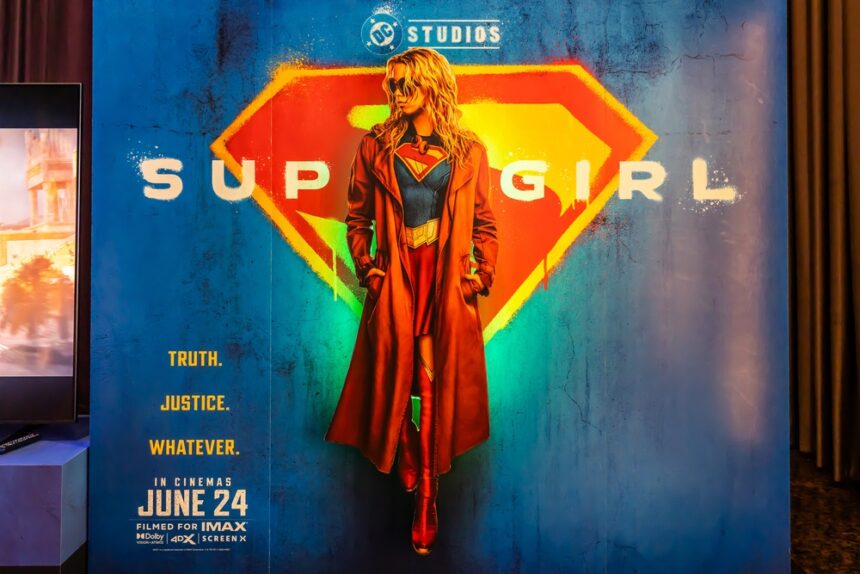
Warner Bros. and DC Studios are confronting mounting financial pressure from Supergirl’s continued underperformance at the box office, with industry analysts warning that the superhero film could finish its theatrical run with losses approaching or exceeding $100 million based on the trajectory of its ticket sales through three weekends since its June 26 debut.
The film opened with approximately $37.1 million domestically in its first weekend, a figure that fell well short of what a production with a reported budget of $170 million would need to signal a path to profitability. The situation deteriorated significantly in subsequent weeks, with the second-weekend decline reaching 76.8 percent as audiences abandoned the film at a pace that exceeded even pessimistic industry projections.
What the numbers show
The per-theater performance of the film through its first three weekends illustrates the challenge in concrete terms. During its second weekend the film averaged approximately $2,387 per theater across more than 3,600 North American locations, a figure that declined further to roughly $1,377 per theater in the third weekend as foot traffic continued to fall. A third-weekend decline of 58.6 percent from the prior week indicates that the film has not found a stable audience willing to sustain it through a longer theatrical run.
By the close of its second weekend, the domestic cumulative total had reached $57.5 million, leaving the film at approximately one-third of the domestic performance it would need to approach break-even against its production budget alone, before accounting for the substantial marketing and distribution costs that are typically added on top of a film’s reported production spend to arrive at the actual total investment that needs to be recovered.
The financial reality for a superhero budget
Films in the superhero genre typically carry substantial marketing budgets alongside their production costs, as the promotional spend needed to reach a global audience for a character-driven franchise film can run to half or more of the production budget itself. For a film that reportedly cost $170 million to make, the combined break-even threshold including marketing would normally be estimated at somewhere between $400 and $500 million in global box office receipts, based on how the studios and distributors share revenue with theater operators.
Supergirl’s global performance has not been disclosed in full, but its domestic trajectory suggests the worldwide total will fall well short of that threshold. The combination of a modest opening, a historically steep second-weekend decline, and continued rapid erosion in the third weekend paints a picture of a film that was unable to generate the word-of-mouth enthusiasm or repeat viewing that allows superhero films with average openings to build toward adequate totals over time.
The context for DC Studios
The underperformance arrives at a sensitive moment for DC Studios, which has been working to rebuild its theatrical franchise under new creative leadership after a period of inconsistent results. A major financial loss on a character introduction intended to anchor future installments of the universe creates both commercial and strategic complications, as it affects how future DC films will be perceived by investors, exhibitors, and audiences.
Director Craig Gillespie and lead actor Milly Alcock were bringing significant individual credentials to the project, and the film represented a meaningful investment in introducing a new version of the character. The box office outcome is not necessarily a verdict on their work specifically, as superhero films are subject to a complex set of variables including franchise positioning, competitive release timing, and the general state of audience appetite for the genre at any given moment. But the financial reality of the theatrical results is distinct from the artistic considerations and will be evaluated on its own terms by the studio.