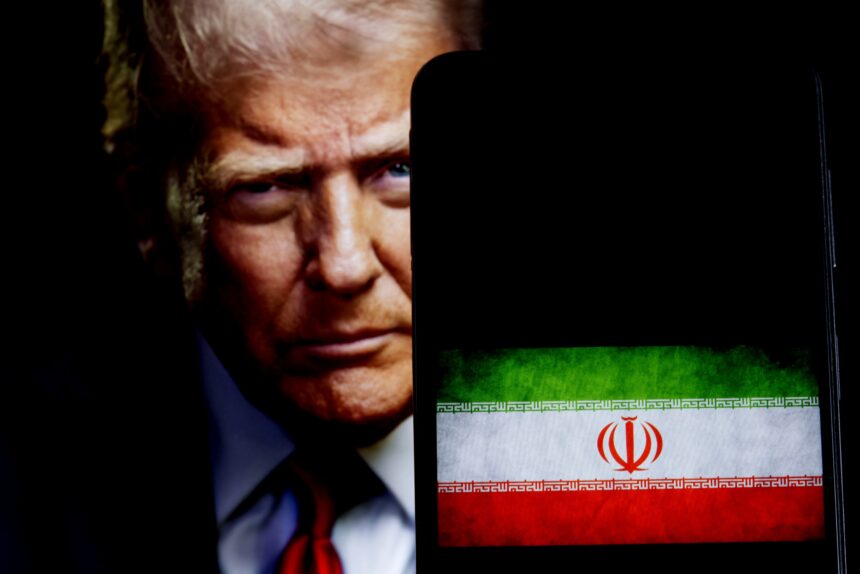
President Trump addressed the nation from the White House on Wednesday evening in a prime-time speech that had been billed as a significant update on the ongoing military conflict with Iran. What followed was nearly 20 minutes of remarks that largely repeated arguments the president had already been making on social media throughout the month-long war, offered contradictory statements about the conflict’s progress, and provided no clear timeline for how or when the hostilities would end.
The address preempted scheduled programming across all major broadcast networks at the request of the White House. Gathered in the foyer to listen were several senior members of the administration, including the vice president and the secretaries of defense, state, and treasury. The visible show of support from the cabinet did little to sharpen the speech’s message or its coherence.
Claims of victory without a path forward
Trump opened his remarks by declaring that the joint US-Israeli military campaign had produced overwhelming results, describing damage to Iran’s navy, air force, and ballistic missile infrastructure as historic in scope. He claimed that a significant portion of Iran’s senior leadership had been killed in the opening days of the conflict and framed the military campaign as a success by virtually every measure he chose to apply.
At the same time, he said the war would continue for another two to three weeks, during which the US would intensify its campaign against Iran’s military and energy infrastructure. The combination of victory declarations and promises of further escalation left the overall message difficult to parse. If the objectives were nearing completion, the ongoing expansion of military action was not easy to reconcile with that framing.
The speech also contained several historical claims that did not hold up to scrutiny, including an assertion connecting Iran to a 2000 attack on a US Navy vessel, an incident for which responsibility has been formally attributed elsewhere through ongoing legal proceedings.
The Strait of Hormuz and the energy contradiction
One of the most closely watched elements of the address was how the president would handle the Strait of Hormuz, the critical waterway through which roughly 20 percent of the world’s oil supply passes and which has remained largely closed since the conflict began. The closure has been a primary driver of the steep rise in global oil prices over the past several weeks.
Trump’s answer was to urge other nations to take the lead in reopening the passage, suggesting that countries dependent on the waterway should deploy their own naval resources to secure it. He also claimed that the United States is effectively insulated from the consequences of the closure because of domestic oil production levels, a position that energy analysts and economists have repeatedly challenged given the globally integrated nature of petroleum markets.
In the same address, the president also suggested the strait would eventually open on its own and that energy prices would recover naturally once the conflict wound down. Those assurances sat uneasily alongside internal White House projections, widely reported in recent days, that oil prices could climb past $150 per barrel if the war extends into a second month with the waterway still restricted.
A public growing weary
The address arrived as public support for the conflict has deteriorated sharply. A poll released the same day found that only about a third of Americans approve of the war, with nearly two-thirds disapproving and a substantial portion of that group expressing strong opposition. Those numbers represent a significant shift from the early weeks of the conflict and place growing political pressure on the administration to show meaningful progress toward a conclusion.
Trump did not directly address the polling in his remarks, though he invoked the families of service members killed since the start of the fighting to argue that withdrawing before completing the mission would be a disservice to those who had already sacrificed. Thirteen American service members have died since hostilities began on February 28.
What comes next
The speech did not alter the fundamental uncertainty surrounding the war. The Strait of Hormuz remains closed, oil prices remain elevated, and the conflict has now stretched past the one-month mark with no formal ceasefire in sight. Trump’s two to three week withdrawal timeline, offered without conditions or verification mechanisms, did little to reassure financial markets or foreign governments watching the situation closely.
For a public that had been told the address would offer something new, the experience was largely one of familiarity. The same arguments, the same claims of progress, and the same absence of a concrete exit plan that have defined the administration’s public communications on Iran for weeks were all present Wednesday night. What was missing was the clarity that both markets and the American public had been waiting for.