Long before Kendrick Lamar turned rap into literature and Snoop Dogg made storytelling cool on the West Coast, there was a kid from south London sitting in a cramped Bronx apartment, entertaining his aunts and uncles with jokes and wild tales. That kid became Slick Rick, and almost 50 years later, hip-hop is still living inside the world he helped build.
This week, the rapper born Ricky Walters will receive a lifetime achievement prize at the Mobo Awards, performing a career-spanning set alongside British artist Estelle. The honor is long overdue for a figure who essentially invented the smooth, conversational storytelling style that would go on to influence generations of artists from De La Soul and Snoop Dogg to Kendrick Lamar himself. Slick Rick accepts it with characteristic humility, expressing simple gratitude to the country where his story began.
Slick Rick’s journey from Mitcham to the birthplace of hip-hop
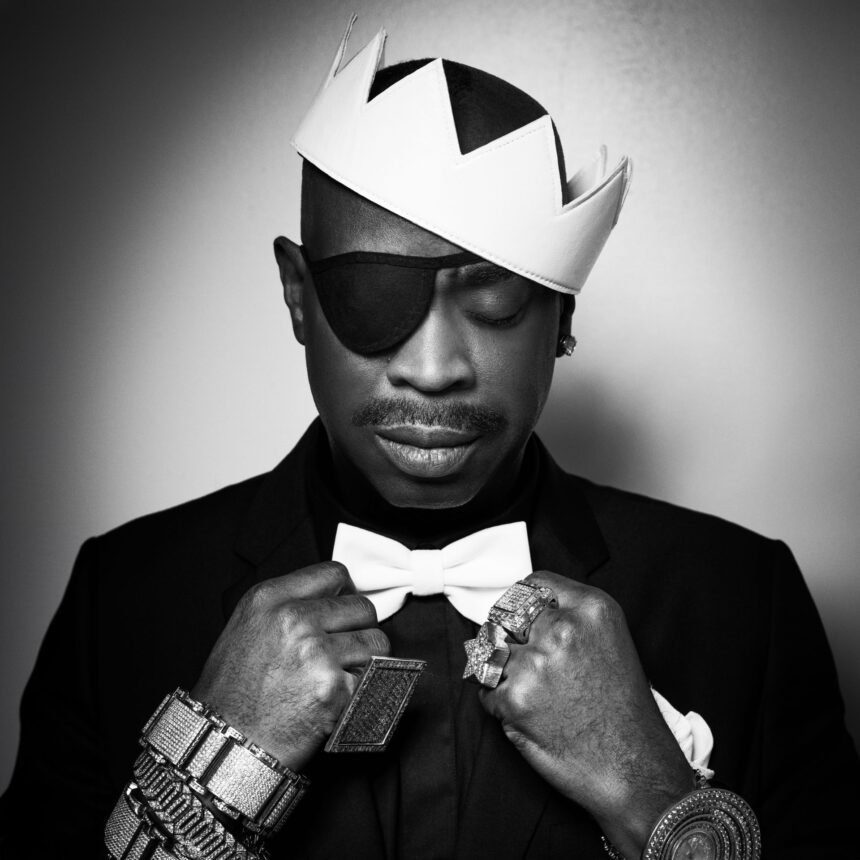
Born in 1965 to Jamaican parents in Mitcham, south London, Walters lost sight in one eye after an accident with broken glass as an infant, leading to the iconic eye patch that became part of his identity. At 11, his family emigrated to the Bronx, arriving in a New York City gripped by financial crisis, rising crime and crumbling infrastructure. They moved in with his grandmother, squeezing into an apartment packed with relatives across every inch of available space.
The city was struggling, but it was also on the verge of something extraordinary. Community gatherings in the park, where DJs would set up sound systems and draw entire neighborhoods together, were giving birth to hip-hop right in front of him. He was immediately drawn in.
At LaGuardia High School of Music and Art, he connected with future rapper Dana Dane, and the two began writing rhymes to impress each other, using nothing but their voices and whatever surface they could bang on. His English-tinged delivery, built from Jamaican intonation, sharp Britishisms and an elevated vocabulary, was already taking shape. He began performing as part of the Kangol Crew, leaning into his heritage with regal accessories and a persona that felt unlike anything else in the Bronx at the time.
The songs that became the foundation of a genre
Legendary hip-hop producer Doug E Fresh caught his performance at an open mic and invited him into the Get Fresh Crew, giving him the name that would follow him everywhere. In 1985, the crew released The Show and La-Di-Da-Di, two tracks that would quietly become foundational texts for the genre. La-Di-Da-Di is now the most sampled hip-hop song of all time, appearing on more than 1,000 recorded tracks. Snoop Dogg famously covered it in full on his landmark 1993 debut Doggystyle, a tribute that Rick has called among the greatest honors of his career.
His debut solo album, The Great Adventures of Slick Rick, released on Def Jam Records, cemented his reputation as hip-hop’s premier storyteller. Songs like Children’s Story demonstrated his ability to write with deliberate narrative structure, bringing cinematic tension to a genre that was still defining itself. Teenage Love showed another dimension entirely, proving he could write earnestly about romance at a time when vulnerability was rarely a feature of rap.
Survival, reinvention and what comes next
His path was not without serious disruption. A conviction for attempted murder following a confrontation with a threatening former associate led to five years in prison. A decade later, immigration authorities detained him for nearly a year and a half, threatening deportation in a case that drew support from some of the biggest names in entertainment. He was eventually granted full pardon and later became a naturalized U.S. citizen.
Those experiences shaped his recent work, including the song We’re Not Losing from his 2024 release Victory Album, which pushes back against political narratives that scapegoat immigrants. He describes the track as a way of voicing frustration with failures of moral leadership, and his perspective carries the weight of someone who has lived through the very policies he is critiquing.
Now, standing at the edge of a new chapter, Slick Rick frames the Mobo lifetime achievement award not as a curtain call but as a door opening. Music, he says, is about enriching your own life first and then bringing that richness to everyone else. After everything he has been through, that philosophy sounds less like a motto and more like a hard-won truth.