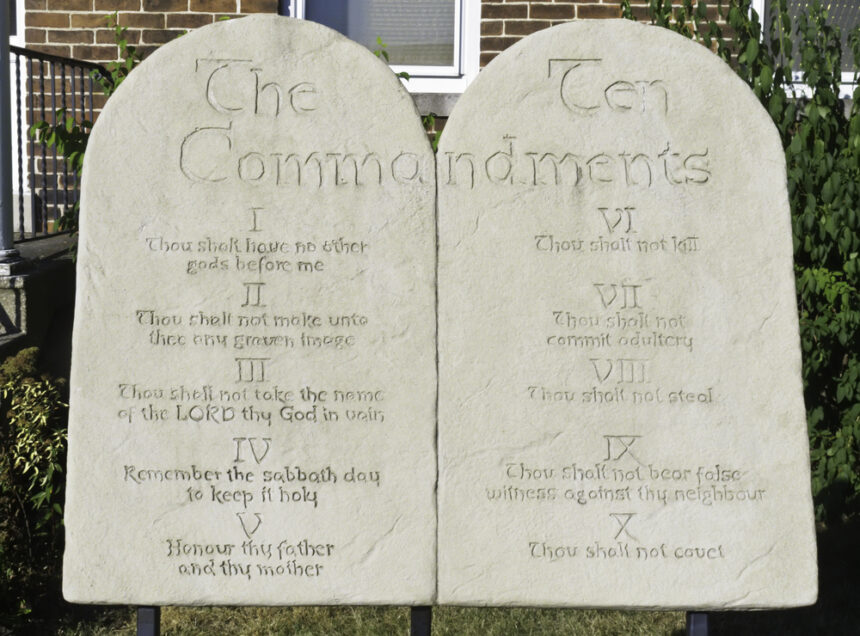
The American Civil Liberties Union asked the U.S. Supreme Court on Aug. 17 to review a federal appeals court decision that upheld a Texas law requiring public school classrooms to display the Ten Commandments, setting up a potential landmark case on the relationship between government and religion.
The U.S. Court of Appeals for the Fifth Circuit cleared the way in April for the Texas law to take effect with a 9-8 ruling in Nathan v. Alamo Heights Independent School District. The ACLU’s petition asks the justices to take up the case and potentially reverse the Fifth Circuit. ACLU lawyers argue the display mandate is an unconstitutional government endorsement of religion.
The Texas law, known as Senate Bill 10, requires a framed Ten Commandments copy to be conspicuously displayed in every public elementary and secondary school classroom, with no additional commentary.
The Fifth Circuit’s reasoning
In upholding the law, the Fifth Circuit concluded it complied with the First Amendment. The majority reasoned that the law does not resemble a historical religious establishment because it does not direct houses of worship, impose religious requirements on individuals, levy taxes to support clergy or require churches to perform civic functions.
The 9-8 margin reflects significant disagreement among the Fifth Circuit judges. The narrow split means the issue divides even the most conservative of the federal appeals courts, and the ACLU’s petition frames it as exactly the kind of contested constitutional question the Supreme Court should settle.
The legal questions at stake
The Establishment Clause prohibits Congress from making laws respecting an establishment of religion. State laws requiring the Ten Commandments in government-run schools have been the subject of significant legal dispute for decades.
The Supreme Court ruled in Stone v. Graham in 1980 that a Kentucky law requiring the Ten Commandments in public schools was unconstitutional. The ACLU relies on that precedent, while supporters of the Texas law argue that the Supreme Court’s more recent religion decisions have shifted the constitutional framework in ways that should allow such displays.
The broader context
Louisiana passed a similar law in 2024, which was also challenged and struck down in lower courts before being appealed. The existence of multiple similar Ten Commandments laws in different states reflects a coordinated effort to bring the question before the Supreme Court with a favorable lower court record.
The Fifth Circuit’s ruling is the most favorable outcome that proponents of Ten Commandments classroom displays have achieved in federal courts, making it a logical vehicle for seeking Supreme Court review.
For the ACLU and civil liberties advocates, displaying the Ten Commandments in public school classrooms is a textbook Establishment Clause violation. For supporters of the law, the Ten Commandments have historical and civic significance that transcends their religious character, and requiring their display does not coerce any student to adopt the religious beliefs they reflect.
Both the ACLU’s Establishment Clause argument and the civic significance counter-argument have been made in federal courts for decades, and the Supreme Court’s willingness to take up the case, or declining, will carry significant signal about where the current court stands on this question. For the ACLU, the stakes extend beyond Texas.