Federal agents seized more than 1,000 pounds of cocaine hidden inside a commercial truck at a California border crossing, uncovering what prosecutors described as the second-largest cocaine seizure in the Southern District of California this year, the Department of Justice announced on July 29.
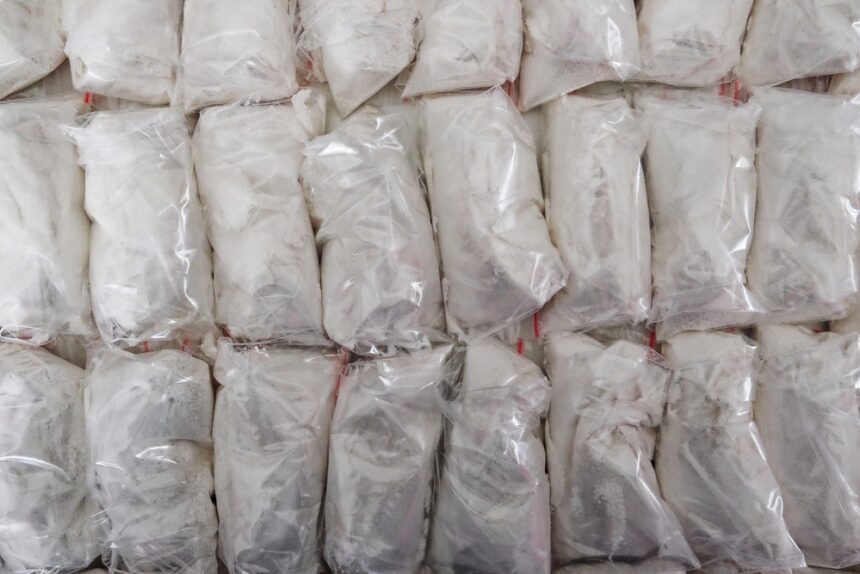
The drugs were discovered at the Calexico Port of Entry, the crossing point linking California with Mexicali, Mexico. Officers from Customs and Border Protection and other agencies X-rayed the truck’s trailer and detected anomalies suggesting the floorboards were not as they appeared. Once the rebar being transported on the flatbed was unloaded, officers lifted the wooden floor to reveal 366 packages of cocaine concealed beneath it, weighing a combined 1,002 pounds. Authorities estimated the street value of the seizure at more than $20 million.
The driver of the truck, a 44-year-old Mexican national, was arrested at the scene and charged with illegally importing cocaine into the United States.
How the discovery unfolded
The interception reflected a detection sequence that border enforcement agencies use at commercial entry points, in which large vehicles are scanned before inspection officers make a physical examination of anything flagged as suspicious. X-ray technology allows agents to identify inconsistencies in cargo density or structure that can indicate hidden compartments or concealed contraband, even when the exterior of a vehicle looks unremarkable.
In this case, the trailer’s floor showed irregular patterns consistent with something beneath the surface. The rebar cargo, a legal and common industrial shipment, provided the cover load that required unloading before the floor could be accessed. The cocaine packages were found after officers removed that material and lifted the flooring.
The method of concealment, building hidden compartments into a vehicle’s floorboards, is a technique frequently used by drug trafficking organizations that exploit commercial freight lanes because of the volume of legitimate cargo moving through those crossings every day. Commercial trucks represent a particularly challenging inspection environment given the scale of cross-border trade. Law enforcement agencies rely on a combination of scanning technology, behavioral indicators and intelligence to identify which vehicles warrant deeper examination.
Context for this year’s seizures
The Calexico seizure is the second-largest cocaine confiscation recorded in the Southern District of California in 2026. The largest came in May, when more than 2,000 pounds of cocaine with an estimated value of approximately $45 million was taken off the market. The two seizures together reflect the volume of cocaine that enforcement agencies in this region are intercepting, even as officials acknowledge that significant quantities make it through undetected.
Drug trafficking through California’s southern border crossings has been a persistent law enforcement challenge. Cartels and trafficking organizations have refined concealment methods over years of operational experience, and the competition between detection technology and concealment techniques is ongoing. When a major seizure occurs, it disrupts the specific supply line involved, but the broader trafficking networks typically reroute or adjust their methods in response.
The Calexico Port of Entry handles an enormous volume of commercial and passenger traffic connecting the Imperial Valley with Mexico. Its status as a major commercial corridor makes it both a high-priority enforcement location and an attractive route for organizations attempting to move contraband into the United States.
What happens next
The suspect faces federal charges related to drug importation, which carry substantial mandatory minimum sentences under federal law. Drug importation charges tied to quantities of this size typically expose defendants to significant prison time if convicted. The case will be prosecuted in the federal court district that covers Southern California.
The 366 cocaine packages will be processed as evidence. The DOJ did not specify in its announcement whether the investigation identified additional suspects or whether the seizure was connected to a broader trafficking network under active investigation. Seizures of this magnitude often generate investigative leads about the organization responsible, though following those leads to prosecution is a lengthy and complex process.