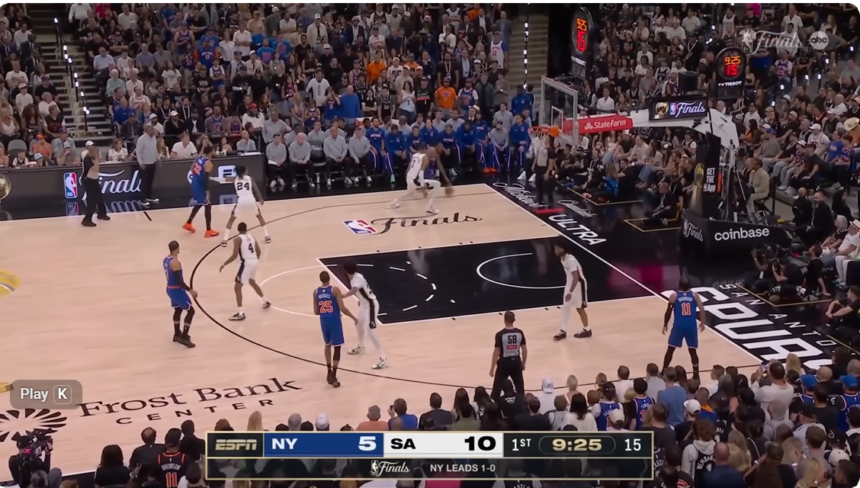
Knicks fans will want to remember every second of what unfolded in San Antonio on Friday night. With the score tied at 104 and 11.8 seconds remaining, Victor Wembanyama grabbed a defensive rebound that should have set up a final Spurs possession. Seconds later, a miscommunicated pass changed everything.
Wembanyama threw the ball up the court toward Stephon Castle, who had his back turned and never saw it coming. Jalen Brunson scooped up the loose ball, drew a foul, and converted the front end of two free throws to give New York a one-point lead with nine seconds remaining. Wembanyama’s 20-foot jumper at the buzzer rattled out, and the Knicks walked out of Frost Bank Center with a 105-104 victory and a 2-0 series lead.
Historic company
The Knicks have now won 13 consecutive playoff games, the second-longest streak in NBA postseason history. More striking is the company they have joined by winning the first two games of a Finals on the road. Only the 1993 Chicago Bulls and the 1995 Houston Rockets have done it before. Both won the championship.
New York last won an NBA title in 1973. Should the Knicks close this series out, they would end a 53-year drought that has defined the franchise’s modern identity.
Towns controls the big-man matchup
Karl-Anthony Towns finished with 21 points, 13 rebounds, and four assists in 33 minutes, and he did most of that damage before Wembanyama found his footing. Towns scored 17 in the first half alone, repeatedly getting the better of Wembanyama with a mix of footwork and physicality that the Spurs have not yet solved through two games.
Wembanyama was not poor by any conventional measure. He scored 29 points, including 22 in the second half as San Antonio mounted a 14-0 run to tie the game in the fourth quarter. Had his final shot fallen, the series would be level and the night would have read very differently for him. It did not fall, and Towns, averaging 19.5 points, 12.5 rebounds, four assists, and a plus-25 rating across both games, holds the clear edge in the Finals’ most anticipated individual matchup.
Spurs coach Mitch Johnson acknowledged his team has not found an answer. The Spurs have held Wembanyama to 40% shooting overall but have been unable to slow Towns, and the coverage breakdowns have been consistent enough that New York continues to run offense through him with confidence.
The turnover that likely decides history
Beyond the final sequence, Wembanyama’s miscommunicated pass was the turning point the Spurs may look back on for a long time. The Spurs had just erased a 14-point deficit and taken a two-point lead with under a minute to play. Then, following Brunson’s tying basket with 57 seconds left, Wembanyama pulled down the rebound that should have been the setup for a final possession and a chance to win in regulation or force overtime.
Instead, the pass, the turnover, the free throw, and the missed jumper unfolded in sequence. Wembanyama took responsibility for the sequence after the game and said the team’s focus had already shifted to Game 3.
Harper gets his minutes, same result
One adjustment Spurs coach Mitch Johnson made from Game 1 was committing to rookie Dylan Harper in the closing minutes. Harper played just four fourth-quarter minutes in Game 1. In Game 2, he was on the floor during the critical stretches and contributed a goaltend bucket, a steal, and a feed to Wembanyama for a three-point play during the Spurs’ comeback run. He finished with 15 points in 32 minutes off the bench.
The adjustment produced better results for San Antonio in the fourth quarter. It did not change the final score.
What comes next
Game 3 moves to Madison Square Garden on Monday, where the Knicks will play in front of a crowd that has waited more than five decades for this moment. Brunson shot 7-for-25 from the field in Game 2, a performance that would have been alarming in almost any other context. He still found a way to matter when it counted. The Spurs, for their part, showed they can compete at this level. Whether they can sustain a comeback from 0-2 in the Finals is a question no team in NBA history has ever answered with a yes.