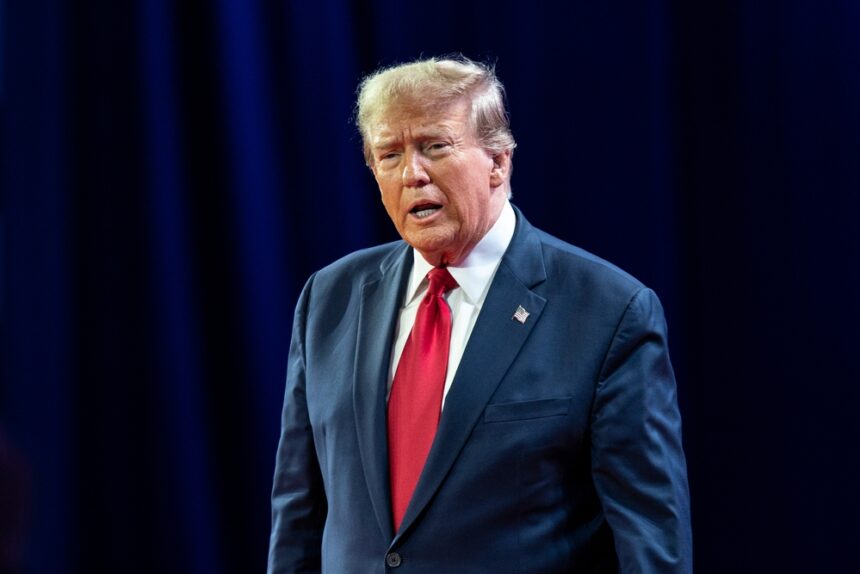
President Trump will undergo his annual physical at Walter Reed National Military Medical Center this week, a routine examination that arrives against a backdrop of recurring public questions about the health of a president who turns 80 next month. The checkup, while standard, comes at a moment when the scrutiny around his physical condition has grown noticeably harder to dismiss.
Trump, whose birthday falls on June 14, became the oldest person to begin a presidential term when he returned to the White House in January 2025. He has consistently positioned himself as vigorous and energetic, a contrast he draws frequently against his predecessor, Joe Biden, who left office at 82 amid sustained concerns about his fitness for the role. That comparison has become a fixture of Trump’s public presentation, but a series of photographs and incidents over the past year have complicated the narrative.
A year of visible ailments
Images circulated in the summer of 2025 showing Trump with swollen ankles and a bruised hand that appeared to have been partially covered with makeup. The White House attributed the ankle swelling to a common vein condition and explained the hand bruise as the result of extensive handshaking. A White House physician said at the time that neither issue indicated anything serious and that tests had found no evidence of deep vein thrombosis or arterial disease.
More recently, photographs showing a blotchy rash on Trump’s neck prompted a fresh round of public attention. His physician addressed the images by saying the president was using a topical cream as a preventative skin treatment, though no specific diagnosis was disclosed. The explanation offered little in the way of detail and did little to quiet the speculation.
Trump has also drawn attention for appearing to close his eyes during several official meetings, including one with his Cabinet. He addressed the observation publicly, framing it as a choice rather than fatigue, suggesting he simply wanted to disengage from a dull moment rather than that he had fallen asleep. The comments drew laughter from the room but kept the subject alive in the press.
The MRI that raised more questions
In October, Trump disclosed that he had received an MRI scan, describing the results in glowing terms and suggesting the physician who reviewed it called it the best outcome he had ever seen. The White House initially provided no details about what prompted the scan, before Trump later clarified it was part of a second physical examination he had undergone that year.
Medical professionals noted that MRI scans are not a standard component of a routine annual physical and are typically ordered to investigate a specific concern or provide detailed imaging of a particular area. The White House did not elaborate on what the scan was intended to assess. A subsequent physician’s memo stated that Trump’s cardiac age, measured through an electrocardiogram, was approximately 14 years younger than his actual age, a figure the administration highlighted as evidence of strong cardiovascular health.
Golf, exercise and the image Trump projects
Trump maintains an active golf schedule and has used it as a proxy for physical vitality in public settings. A recent Oval Office appearance touched on his exercise habits when his health secretary suggested the president walks significant distances during each golf round. Trump responded by clarifying that the mileage applied only when he was not using a cart, a moment that landed as self-deprecating humor but also undercut the image of rigorous physical activity his team had been cultivating.
The broader context includes former President Biden’s recent disclosure that he has been diagnosed with an aggressive form of prostate cancer that has spread to his bones and that he is undergoing radiation therapy. That development, coming shortly after Biden left office, has sharpened public interest in the health of aging presidents and added weight to questions that might otherwise be treated as routine.
Tuesday’s examination at Walter Reed will produce a report, though the level of detail made public will ultimately be a decision for the White House. In past administrations, those reports have ranged from comprehensive to carefully limited. The country, for its part, will be reading closely.