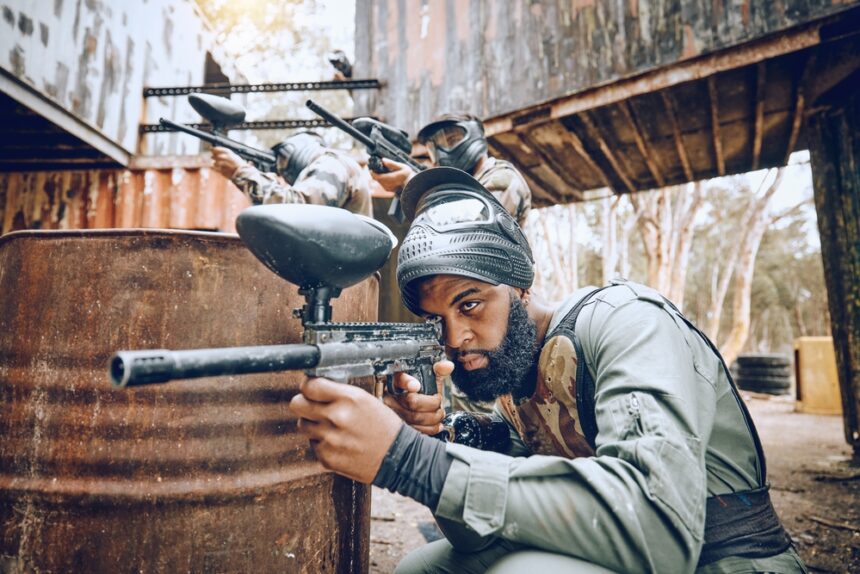
There is a moment in a paintball match — crouched behind a rusted barrel, marker aimed, heart pounding — where every other noise in the world disappears. No screens. No notifications. Just strategy, instinct, and the very real possibility of taking a hit from someone who wants to win just as badly as you do. That moment is exactly why paintball is surging back into the cultural conversation, and why a new generation of players is discovering what veterans have always known— this sport is built different.
Once dismissed as a weekend novelty, paintball has quietly evolved into one of the most tactically demanding, physically intense, and genuinely thrilling extreme sports on the planet. And the numbers are starting to reflect what players on the field already feel — this game never actually left. It just waited for the world to catch up.
Paintball Is Not What You Think It Is
Most people who have never played picture something chaotic and messy — a birthday party activity with rented gear and no real stakes. That image is about two decades out of date. Modern paintball is a precision sport. The equipment alone tells the story— today’s markers feature electronic firing modes, Bluetooth-enabled performance tracking, and customizable aesthetics that turn a weapon into an extension of the player holding it. Protective masks have evolved dramatically, offering full-face protection without sacrificing sightlines or mobility. High-pressure air systems have replaced the old CO2 tanks, giving players more consistent shots and better control over every single engagement.
The formats have diversified just as sharply. Speedball, played on tight symmetrical fields with inflatable bunkers, rewards athleticism and fast decision-making. Scenario paintball drops teams into mission-based environments that lean into military simulation, strategy, and communication. Woodsball — the original format, played in natural terrain — remains the most widely played version for casual and recreational participants. Each format attracts a different kind of player, and together they have built a community far larger and more serious than most outsiders realize.
The Numbers Behind the Revival
Paintball participation in the country reached 2.67 million players in 2023, up from 2.56 million in 2021 — a steady climb that reflects renewed interest across age groups and skill levels. The global paintball equipment market is projected to reach around $750 million, with a compound annual growth rate of roughly 6.5 percent expected through 2033. That kind of sustained growth does not happen in a dying sport. It happens in one that is actively recruiting new players, retaining its existing base, and expanding into markets that previously had little exposure to the game.
The Asia-Pacific region, particularly China, is projected to see substantial growth in market share through 2031, signaling a shift in global dynamics as emerging economies begin investing in recreational and competitive paintball infrastructure. Meanwhile, corporate wellness programs and military simulation initiatives have opened a lucrative new channel for the sport, bringing in participants who might never have considered stepping onto a paintball field through traditional recreational channels.
Why This Generation Is Choosing Paintball
There is something happening with younger players and extreme sports that goes beyond adrenaline. The generation currently driving paintball’s growth did not grow up watching it on ESPN in its early-2000s peak. They found it through social media, through gaming culture, and through a genuine hunger for physical experiences that screens simply cannot replicate. The rise of e-sports and virtual reality has paradoxically expanded the paintball market by attracting players who want to bring the tactical elements of competitive gaming into a real-world, full-body environment.
Low-impact paintball has also played a significant role in broadening the sport’s appeal. Using lighter projectiles at reduced velocity, low-impact formats have made the game accessible to younger players, first-timers, and corporate groups who might have been put off by the physical intensity of traditional play. Once someone experiences the strategy and the rush of a real match, the transition to standard paintball tends to follow naturally.
The Culture Is the Sport
What separates paintball from most extreme sports is the community that surrounds it. The NXL — the National X-Ball League — runs one of the most organized competitive circuits in action sports, with thousands of registered teams competing at regional and national levels. Online forums, YouTube channels, and social media pages dedicated to paintball attract hundreds of thousands of followers who debate gear, break down tournament footage, and introduce new players to the culture. The sport has a language, a history, and an identity that rewards deep engagement.
The revival also has a tactical dimension that resonates widely. Paintball demands communication, spatial awareness, quick thinking under pressure, and the ability to adapt when a plan falls apart in real time. These are not just athletic skills — they are life skills that players carry off the field. It is a sport that builds something, and the people who play it tend to know it.
The man in the photo — masked up, locked in behind cover, marker trained on a target no one else can see yet — is not just playing a game. He is operating. And in 2026, more people than ever are figuring out that they want to do the same.