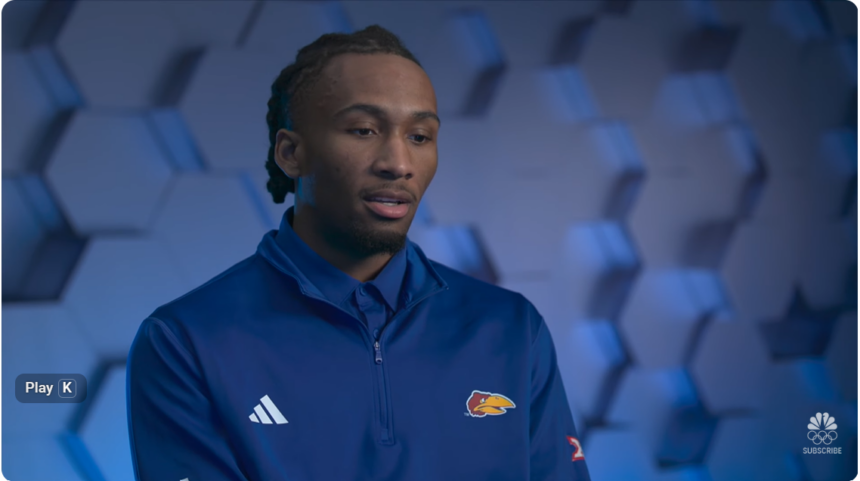
Darryn Peterson arrived at Kansas as the presumptive top pick in the 2026 NBA Draft. That consensus did not survive his freshman season intact.
What followed was a campaign defined as much by what Peterson could not do as by what he showed when healthy. Full-body cramping that began in September limited his minutes throughout the year, disrupted his rhythm, and left evaluators with a narrower sample than anyone anticipated when the season started. The result is a draft class with a legitimate No. 1 debate for the first time in years, and a player whose landing spot will depend as much on his medical evaluation as his highlight reel.
Where the projections stand
Yahoo Sports analyst Kevin O’Connor placed Peterson fifth overall in his latest mock draft, projecting him to the Utah Jazz. The projection acknowledges both sides of the evaluation problem Peterson presents. His shot-making ability, described as capable of producing from anywhere on the floor, combined with a 6-foot-6 frame and the fluidity of movement that scouts associate with long-term star potential, makes a compelling case for a top-three selection. His defensive tools and off-ball awareness add layers that pure scorers at his age rarely possess.
The hesitation comes from the medical uncertainty. O’Connor noted that league sources have indicated since midseason that Peterson’s final draft position could shift depending on what team doctors find during pre-draft evaluations. The cramping situation, the missed time, a noticeable absence of the explosive athleticism Peterson showed before his health declined, and stretches where heavy minutes coincided with reduced offensive production have collectively kept teams from locking him into the top three with confidence.
Bleacher Report’s Jonathan Wasserman reads the same evidence differently and has Peterson ranked second overall. Wasserman’s case rests on the argument that Peterson’s shooting range, defensive versatility, and movement without the ball represent a profile that does not disappear with injury history, and that his most recent performances, which included games above 30 minutes, suggest the cramping issues have become more manageable as the season progressed.
USA Today’s latest projection places Peterson third overall to the Washington Wizards, splitting the difference between the two most prominent external assessments.
What Peterson’s season actually showed
Despite the health limitations, Peterson averaged 20.2 points, 4.2 rebounds, 1.6 assists, and 1.4 steals across 24 games. Those numbers, produced while playing through a condition he described as traumatic and a consistent factor from the opening months of the season forward, represent a meaningful argument in his favor. Kansas coach Bill Self acknowledged the cramping as a significant obstacle throughout the year.
The concern that emerged as the season extended into conference play and March Madness was a decline in shooting percentage during the stretches when Peterson’s minutes increased. For evaluators trying to assess whether the production limitations were purely health-related or reflected something about how his body holds up under load, that trend introduced questions that pre-draft medical workouts will need to answer.
Peterson continued playing through the Big 12 tournament and into March Madness, which carries its own signal. Teams will note that he did not shut himself down when a shutdown decision might have been reasonable.
For comparison, North Carolina center Caleb Wilson, whom O’Connor projected above Peterson at fourth overall, also missed substantial time during his freshman season due to multiple injuries and was eventually shut down entirely, missing the full NCAA tournament. Wilson’s situation illustrates that injury-affected freshman seasons are not disqualifying at the top of this class.
Why the Jazz projection makes sense
O’Connor’s rationale for placing Peterson in Utah centers on roster context. The Jazz hold a pick that they used on Ace Bailey one year earlier under comparable circumstances, and Bailey’s development has validated that approach. A team with Lauri Markkanen, Jaren Jackson Jr., and Keyonte George already in place does not need an immediate contributor from a rookie. The environment reduces pressure and allows for the kind of gradual integration that a player managing a health history would benefit from entering a professional environment.
Whether Peterson lands fifth or second will become clearer after the May 10 draft lottery determines which franchises will be selecting at the top and after pre-draft medical evaluations give teams the information they have been waiting on since September.
The talent case for Peterson at any of those positions is not seriously in dispute. The health case is the only open question, and it is the one that will determine how far he travels on draft night.