
The Trump administration’s top economic official is sending a softer message to Beijing. Speaking to a room of business and policy leaders, he described a relationship built on balance rather than conflict.
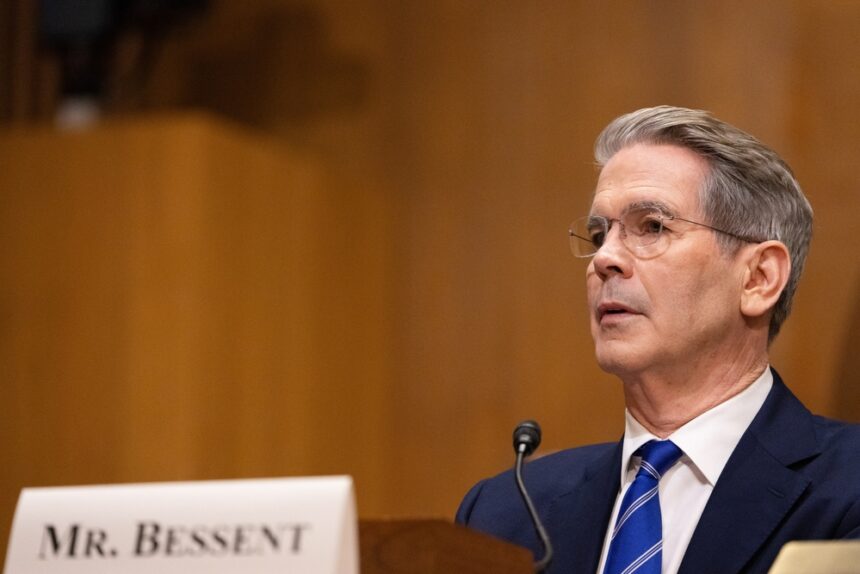
Treasury Secretary Scott Bessent called for a more balanced economic relationship between the United States and China on Tuesday, Nov. 10, 2026, saying the U.S. must produce more of what it consumes and China must consume more of what it produces.
What did Scott Bessent say?
Speaking at a gala in New York hosted by a nonprofit group that promotes ties between the two countries, Bessent called the relationship one of the most important of this century.
Scott Bessent said the goal is to reduce risks, not to cut economic ties between the two nations. The American economy has become too dependent on foreign supply, he said, while China’s has grown too reliant on foreign demand.
Working together, he said, both economies can grow stronger without continuing the imbalances between them. He said the approach does not reflect hostility and aims to restore a spirit of reciprocity. He made the remarks in prepared comments released by the Treasury.
How does Scott Bessent describe Trump and Xi?
Scott Bessent said the relationship between President Donald Trump and Chinese leader Xi Jinping amounts to a genuine friendship. He noted that the two leaders have met in person unusually often this year.
Trump and Xi are expected to meet at the APEC summit in Shenzhen, China, on Nov. 18 and 19, in what would be their third meeting this year. The leaders are expected to discuss trade, technology and other issues.
What is behind the push for balance?
The United States has run a large trade deficit with China for decades, buying far more goods than it sells. China, meanwhile, relies heavily on exports to drive its economy.
The administration has used tariffs and other measures to bring manufacturing back to the U.S. and to pressure China to buy more American goods. Those efforts have included tariffs on a wide range of Chinese goods.
Economists have long urged China to boost spending by its own consumers, which would make its economy less dependent on selling to other countries. Chinese leaders have also said they want to boost domestic consumption.
Where do trade talks stand?
The two countries recently extended a pause on port fees targeting each other’s ships by two more months, part of a trade truce reached in Busan, South Korea, in October 2025.
U.S. officials have pressed China to follow through on promises to buy American farm products and to keep supplying rare earth minerals, which are used in electronics and military equipment.
That truce now runs only until January unless the two sides act again. Negotiators on both sides are working to extend it further.
Who is Scott Bessent?
Scott Bessent, a former hedge fund manager, has served as Treasury secretary since early 2025 and has led many of the administration’s trade talks with China. He previously founded an investment firm and worked for investor George Soros.
His remarks struck a more conciliatory tone than some earlier statements from the administration, which has often described China as a top economic rival.
Critics argue that friendly words may not resolve deep disputes over technology, security and trade, while supporters say steady diplomacy can help avoid costly escalation. The recent controversy surrounding Nvidia and Chinese intelligence has added to tensions over technology.
As the Shenzhen meeting approaches, Scott Bessent’s message suggests Washington hopes to keep the relationship on stable footing. Investors and businesses on both sides will be watching closely.