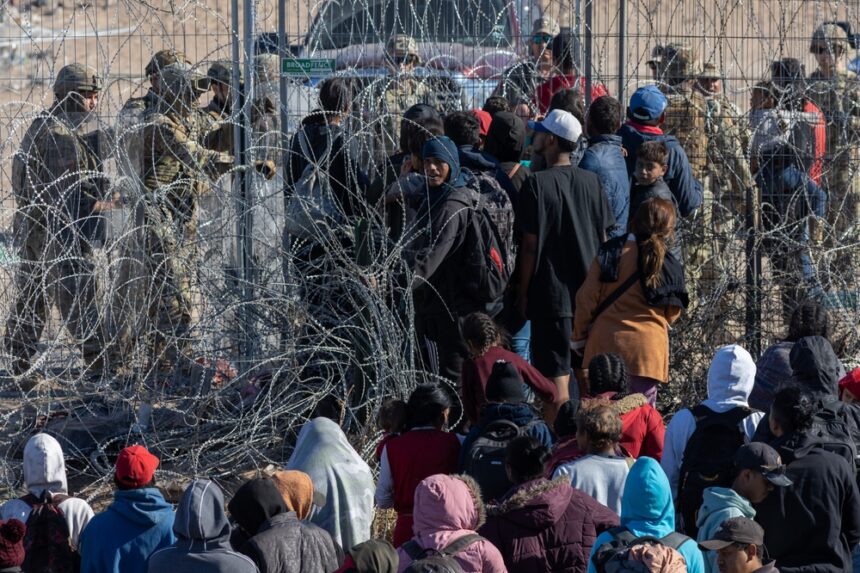
A group of migrants that left Honduras on Sept. 20 has crossed into Mexico, with US officials confirming on Sept. 29 that they are tracking its movement toward the southern border.
How many people are involved?
About 300, according to a local news outlet in southern Mexico cited in the reporting. That figure is worth stating plainly because groups of this kind have historically numbered in the thousands, and 300 is modest by that standard. No US agency has published its own estimate.
Where did it start and where is it now?
The group left San Pedro Sula, Honduras, on Sept. 20 and has entered Mexico. It calls itself Fe y Esperanza, meaning Faith and Hope. The distance from southern Mexico to the US border is roughly 2,000 miles, and groups travelling this way typically take weeks to months, with numbers falling substantially along the route through attrition, Mexican enforcement and people settling or turning back.
What have US officials said?
That the group will not be permitted to cross. The Department of Homeland Security said it is monitoring the movement with international partners and that anyone attempting to enter unlawfully will be apprehended, prosecuted and removed. The agency’s statement was delivered in notably political terms, referencing prior administration policy directly.
What does the law actually permit?
More nuance than a blanket statement conveys. Entering between ports of entry without authorisation is unlawful. Presenting at a port of entry and requesting asylum is lawful under US statute and treaty obligations, regardless of how a person reached the border. Whether a claim succeeds is a separate question decided later and most do not. Recent policy has sharply restricted access to that process, and the extent of those restrictions is being litigated, so what a person arriving today can actually do is contested rather than settled.
Why do people travel in groups?
Safety and cost. The route through Mexico carries serious risk of kidnapping, extortion and violence, particularly for women and unaccompanied minors. Travelling visibly and in numbers offers some protection and removes the need to pay smugglers. That is the practical reason these formations appear, independent of any political dimension.
What is driving departures from Honduras?
Conditions that have persisted for years. San Pedro Sula has among the highest homicide rates in the hemisphere, and the country combines gang control of neighbourhoods with limited economic opportunity and repeated climate shocks to agriculture. People leaving are responding to specific circumstances rather than to any single announcement.
How much will reach the border?
Historically, a fraction. Mexican authorities have dispersed, bussed or processed most previous groups well before the border, and attrition along the route is substantial. A group of 300 in southern Mexico is not 300 people arriving in Texas.
What should readers watch?
The size of any group that actually reaches the border, and how port of entry asylum access is being handled at that time. Both will be considerably clearer in several weeks than they are now.