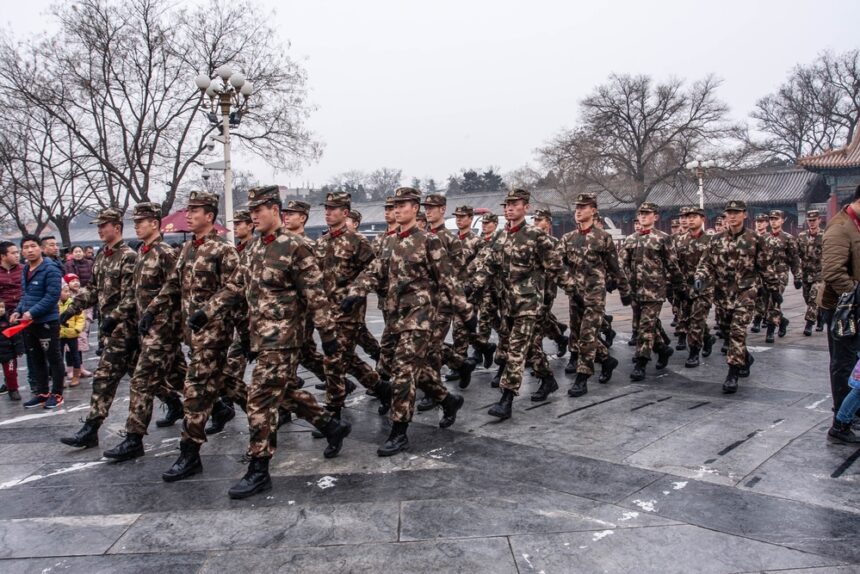
China removed two of its most senior military commanders from the national Central Military Commission on Aug. 28, continuing a pattern of turbulence within the upper ranks of the armed forces under Xi Jinping’s leadership.
Zhang Youxia, once considered China’s most senior general and vice chair of the CMC since 2018, was stripped of his position, according to a brief statement from the National People’s Congress Standing Committee released through state media Xinhua. The statement gave no reason for the dismissal. Liu Zhenli was also stripped of his CMC membership in the same announcement.
Both Zhang and Liu had been placed under investigation in January on allegations of serious violations of discipline and laws, a formulation that in Chinese political practice typically refers to corruption or disloyalty to the party. Zhang was also a member of the Communist Party’s ruling Politburo. Neither man had yet been formally or publicly expelled from the party’s own military commission, which is technically separate from the state body but in practice holds the actual authority.
The removals follow the separate expulsion of two other senior commanders from a party-controlled legislature. Two parallel CMC structures exist, one affiliated with the state and one within the party, which share the same personnel and leadership, with the party body holding effective power.
The pattern of military purges
The dismissals represent the latest episode in a sustained wave of personnel changes at the highest levels of China’s armed forces that has accelerated since approximately 2023. Senior commanders across multiple branches of the PLA, including the Rocket Force, which controls China’s nuclear arsenal, have been removed, investigated or replaced in rapid succession.
The scale and pace of the removals have been unusual even by the standards of Chinese political practice, where leadership transitions and anti-corruption campaigns have historically resulted in periodic purges. Analysts who track the PLA have noted that the pattern suggests Xi Jinping has found the armed forces less fully under his control than previously assumed, and that the anti-corruption campaign is being used both to remove genuinely corrupt officials and to consolidate political loyalty at the command level.
Zhang Youxia’s removal is particularly significant. He was among the most senior figures in China’s command structure and had served at the apex for years. His placement under investigation in January, while he still nominally held the CMC vice chair position, was itself an unusual signal of how far the investigation had penetrated the top of the hierarchy.
What the removals mean for the PLA
The CMC is the body through which Xi exercises direct control over the Chinese military. It functions as the command authority for the PLA and reports to Xi as the party’s general secretary and chairman of both the party and state CMC bodies. Removing commanders at this level requires Xi’s direct involvement and signals both the scope of the investigation and the degree of instability at the top of the command structure.
The absence of public explanation for the dismissals is consistent with how China handles ongoing investigations. Formal party expulsion and possible criminal proceedings typically follow the initial removal from official positions, sometimes by months or years.
The removals also raise questions about continuity in planning and command at a moment when China is engaged in complex strategic activities across the Taiwan Strait, the South China Sea and its other regional interests.