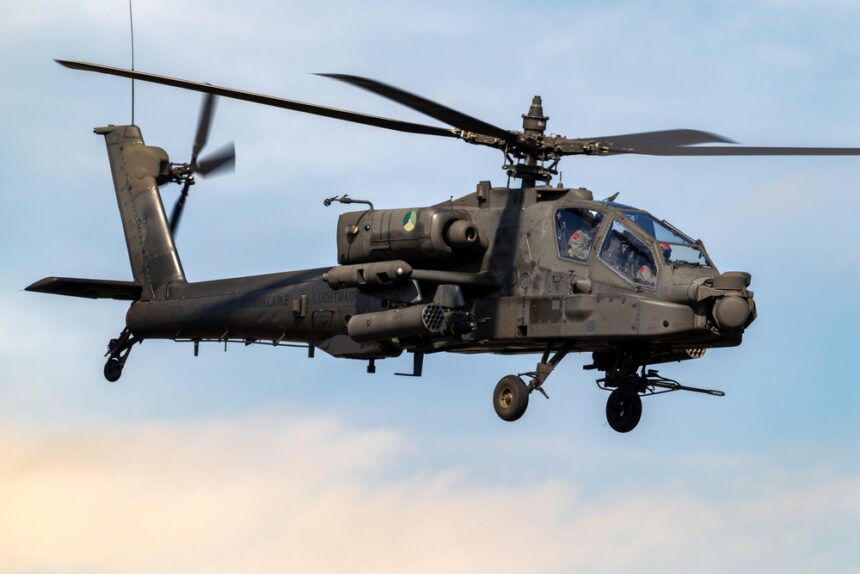
The Army announced Wednesday it would resume Apache helicopter training flights after suspending them for nine days following a crash near Fort Hood, Texas, that killed two soldiers on Aug. 12.
Chief Warrant Officer 2 Deontre T. Huey, 34, of Killeen, Texas, and Warrant Officer Seth L. Olmstead, 25, of Belton, Texas, died when their Apache went down in a grassy field in the vicinity of Salado, approximately 30 miles from Fort Hood. They were the only crew members aboard.
The Army said the decision to resume training flights came after a thorough review of safety procedures and flight operations. The Combat Readiness Center at Fort Rucker, Alabama, continues to investigate the cause of the crash, and that investigation remains ongoing.
In its announcement, the Army expressed condolences to the families and fellow soldiers of those killed, saying it remained deeply saddened by the loss and acknowledged the lasting impact the two warrant officers had on the Army community.
The Apache helicopter and its training program
The Apache is the Army’s primary attack helicopter, used for close air support, anti-tank operations and armed reconnaissance. The Apache training program is centralized at Fort Rucker, which serves as the Army’s aviation center of excellence and has trained military pilots across helicopter platforms for decades.
Pausing training flights after a crash is standard protocol, giving safety officers time to assess whether the incident reflects a systemic issue with the helicopter, a maintenance deficiency or a circumstance specific to the accident. A nine-day suspension that concludes with a safety review and a return to flight operations is consistent with past military practice.
The statement did not specify what the safety review found or whether any procedural changes were implemented before training resumed. The full Apache accident investigation at Fort Rucker could take months to complete and may produce findings that affect training protocols even after flights have restarted.
The soldiers who died
Huey was 34 and based in Killeen, Texas, a city adjacent to Fort Hood. Olmstead was 25 and from Belton, Texas. Both were warrant officers, a rank that in the Army aviation community typically designates experienced pilots who are specialists in their aircraft rather than commissioned officers on a command track.
Warrant officers qualified on the Apache represent a significant investment of training and operational experience. The loss of two in a single accident is felt acutely within the tight-knit Army aviation community, and the timing of the crash, during a training flight near the installation where these pilots were stationed, adds particular weight to the families’ grief.
Its statement said thoughts are with the families, loved ones and fellow soldiers of both men.
The crash site and the investigation
The helicopter went down in a grassy field in the vicinity of Salado, a small town in Bell County approximately 30 miles south of Fort Hood. The terrain is largely rural and flat, and the crash site’s distance from populated areas means the immediate public safety impact was limited to the two crew members aboard.
The Combat Readiness Center at Fort Rucker is responsible for investigating aviation accidents and producing findings that inform safety policy across the service. Its investigations typically assess pilot factors, aircraft systems, maintenance history, weather conditions and procedural compliance in reaching conclusions about probable cause.
No probable cause or contributing factors have been announced.