The Trump administration has canceled a joint military exercise with South Korea that had been scheduled for September, Seoul confirmed Monday, citing constraints on American forces stemming from the ongoing conflict with Iran.
A South Korean military spokesman said the U.S. Marine Corps notified South Korean forces in June that its ability to deploy troops for the Ssangyong amphibious landing exercise this year would be limited due to the situation in the Middle East. The two countries are continuing consultations on when the exercise might resume, he said, without providing a timeline.
What Ssangyong is
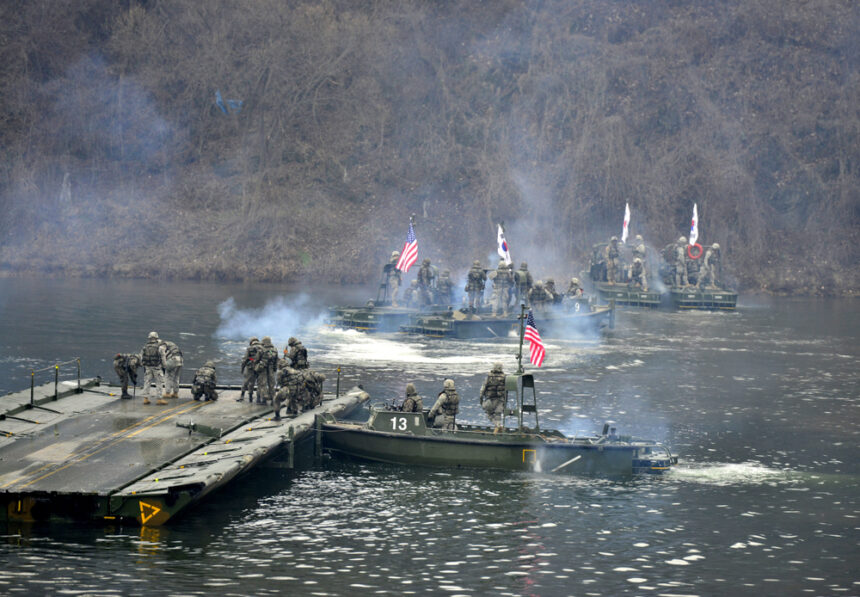
Ssangyong, which translates to “two dragons” representing both nations, is a joint amphibious landing exercise designed to strengthen combined combat readiness and improve interoperability between American and allied forces. According to the U.S. Navy’s Pacific Fleet, the exercise advances the Marine task force capabilities and command-and-control functions through combined training and amphibious operations.
Amphibious landing drills rehearse the kind of coordinated operation that would be necessary in a regional conflict, where geography and coastal access would play a significant role.
The Iran conflict’s reach
The cancellation illustrates the degree to which the U.S. military conflict with Iran is affecting American force commitments around the world. The Trump administration’s notification to Seoul in June that U.S. Marine forces would be constrained signals that planning for the Persian Gulf theater had already begun pulling resources away from the Pacific months before the September exercise date.
Trump has previously described his policy in personal terms, referencing his relationship with Kim Jong Un as a factor in scaling back exercises. Pyongyang has historically viewed such drills as provocative. Whether the Iran conflict constraints align with Trump’s diplomatic calculations remains unclear from the military’s statement.
The alliance context
The South Korea alliance is one of the most significant American military relationships in Asia, with approximately 28,500 U.S. troops stationed on the peninsula. Joint exercises maintain readiness and demonstrate deterrence to North Korea.
Trump administration cancellations of exercises are watched as signals of American commitment and strategic priorities.
Seoul’s statement that consultations are continuing suggests the South Korea alliance relationship remains intact and the cancellation is a logistical consequence of Iran rather than a Trump policy shift.
Seoul has maintained a carefully neutral position on the conflict, which complicates the bilateral dynamic. It imports significant volumes of oil from the Middle East and has strong economic relationships with the region, making it reluctant to take public positions on the Iran conflict even while hosting American forces on its soil.
The next Ssangyong exercise will depend on how the Iran situation develops and whether U.S. Marine Corps capacity in the Pacific recovers within a timeframe that allows a rescheduling before year’s end.