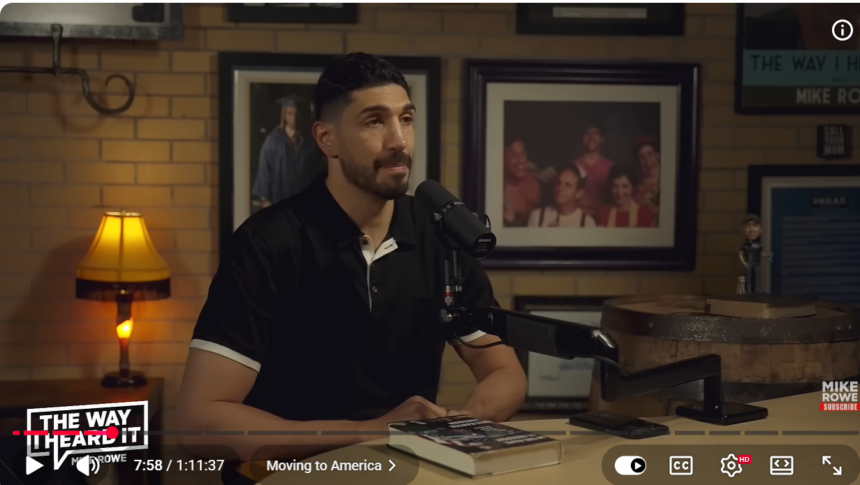
Former NBA player Enes Kanter Freedom announced Today that he is declaring himself eligible for the 2027 WNBA Draft, arguing that the league’s rules around self-identification and inclusion make him a qualified prospect. The announcement, posted on social media, came amid an ongoing debate within the WNBA over whether transgender athletes should be allowed to compete in women’s sports.
What did Kanter Freedom actually say?
In a video posted to social media wearing an orange WNBA sweatshirt, Kanter Freedom said his team had reviewed the league’s eligibility criteria and concluded he qualifies based on current guidelines around self-identification. He said he was not trying to mock or disrespect any community, and framed the move as a test of whether the WNBA would apply its stated inclusion principles consistently. The post had drawn more than 2 million views within hours of being shared.
What sparked this debate in the first place?
The controversy traces back to comments made roughly two weeks earlier by Indiana Fever guard Sophie Cunningham, who said she wanted to protect young girls in sports from competing against biological men, while maintaining that her comments were not rooted in hostility toward transgender people. Cunningham later sought to distance herself from some of the reaction to her remarks. Her comments drew pushback from several WNBA figures, including Minnesota Lynx head coach Cheryl Reeve, who wore a shirt reading trans kids belong during a game, and Golden State Valkyries forward Gabby Williams, who said this week that she would welcome a transgender athlete on either team in a matchup.
Does the WNBA have a policy on transgender athletes?
The league’s collective bargaining agreement states that only players who are women are eligible to compete, but the language does not explicitly address transgender athletes one way or another. The WNBA has not issued a public statement clarifying how that rule would apply to a transgender or self-identifying player, and league officials were not asked about Cunningham’s comments during a recent press availability with Commissioner Cathy Engelbert.
How has the WNBA community reacted to Kanter Freedom’s announcement?
Reaction has split sharply along the same lines as the broader debate. Some commentators aligned with Cunningham’s position praised the move as an effective way to test whether the league’s inclusion stance would hold up in practice. Others have dismissed it as a bad faith stunt designed to mock transgender athletes and inclusion advocates rather than engage with the underlying issue seriously. Kanter Freedom, who has not played in the NBA since 2022 and has been a vocal critic of figures including LeBron James and the Chinese government, is widely expected not to be drafted regardless of his eligibility declaration.
What happens next?
The 2027 WNBA Draft is still months away, and the league has given no indication that it plans to address eligibility rules around self-identification before then. Whether Kanter Freedom’s declaration prompts any formal response from the league remains unclear.
Bottom line
The episode reflects a broader, unresolved debate within women’s professional sports over how leagues should balance inclusion policies with concerns about competitive fairness, a debate that has intensified across multiple sports in recent years without a clear consensus emerging on either side.