Two Chinese research vessels passed through waters claimed by the United States in the Arctic this week, prompting the U.S. Coast Guard to deploy a cutter to actively monitor their movements in what officials described as the first Chinese passage through this particular area recorded this year.
The ships, Xue Long and Xue Long 2, transited north through the U.S. exclusive economic zone and over the extended continental shelf in the Bering Sea, the body of water separating Alaska from Russia. The Department of Defense announced the passage in a July 20 statement, noting that a Coast Guard cutter was dispatched to shadow the vessels under an operation called Frontier Sentinel, designed to assert American rights in the region and position forces to respond quickly to any activity deemed threatening.
The Coast Guard said the mission is intended to ensure foreign ships operating in U.S.-claimed waters comply with international rules, which require vessels conducting research in those areas to obtain permission from the United States before beginning their work. Ships conducting research are also required to share their findings with Washington. There was no indication in the department’s statement whether the Chinese vessels had obtained the required clearance.
A familiar route, a new level of attention
The passage is being framed by U.S. officials as part of a broader pattern of increased foreign activity in the American Arctic that has accelerated in recent years and is expected to intensify during the current summer season, when ice conditions make passage more accessible. Officials described the level of activity as heightened relative to prior years, without specifying what form that activity has taken beyond vessel transits.
The Xue Long and Xue Long 2 are well-known assets of Chinese polar research. Both ships have conducted expeditions to the Arctic and Antarctic for years. The presence of research vessels in international or contested waters is not unusual, but the timing and route of this transit, moving over the U.S. extended continental shelf in the Bering Sea, placed it in a zone where Washington asserts specific sovereign rights over resource extraction and scientific research.
The extended continental shelf extends beyond the standard 200-nautical-mile exclusive economic zone and represents an area where the United States claims additional rights under international law, though those claims involve ongoing international discussions and are not universally accepted.
What Frontier Sentinel is designed to do
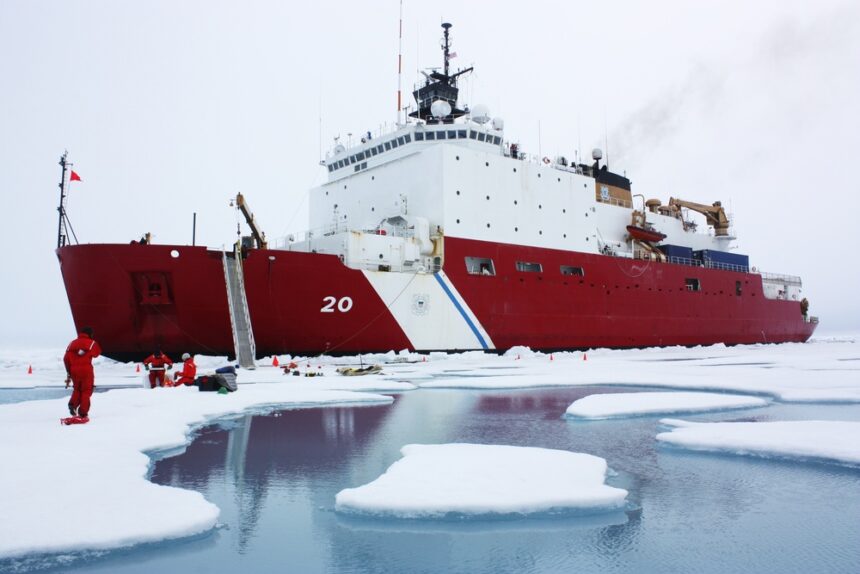
The deployment of the Coast Guard cutter Munro under Operation Frontier Sentinel reflects an established approach to monitoring foreign vessels in sensitive maritime zones. The operation is built around active shadowing and documentation rather than interception, allowing the U.S. government to demonstrate awareness and presence without escalating an encounter that, in the case of research ships, typically falls short of the threshold for confrontation.
The distinction matters because research vessels occupy a complicated space in maritime law. They are not warships, and their passage through international waters or exclusive economic zones carries different legal weight than military transit. The key legal questions center on whether the specific activities being conducted require permission under the rules governing the coastal state’s rights in those waters.
Why the Arctic is increasingly contested
The Arctic has become a focus of intensifying great-power competition as climate change continues to reduce sea ice and open new shipping lanes and access to natural resources. Russia, China, the United States, Canada and several Nordic nations all have interests in the region, and the legal framework governing Arctic waters remains a source of friction.
China does not share a border with the Arctic but has declared itself a near-Arctic state and invested significantly in polar research infrastructure, of which the Xue Long vessels are the most visible components. American officials have grown increasingly attentive to Chinese activity in the region, viewing it as part of a broader pattern of capability-building in areas of strategic importance.