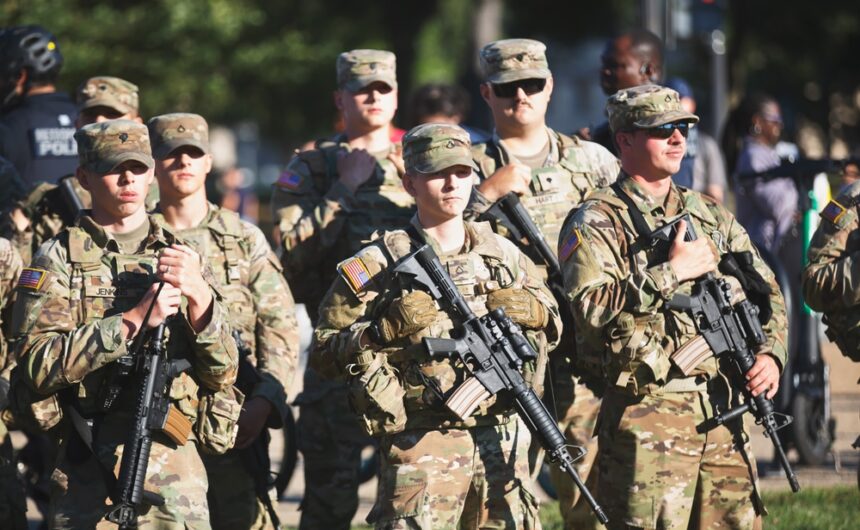
National Guard troops stationed in Washington will now remain in the nation’s capital through the end of President Donald Trump’s second term, following an extension of their deployment that the Pentagon confirmed on Thursday.
The mission, which had been set to expire at the end of 2026, has been extended to January 20, 2029, the date on which the next president would be inaugurated. The troops will stay in Washington until that date unless Trump chooses to end the deployment earlier. The White House did not respond to requests for comment, and the joint military task force overseeing the operation referred questions to the administration.
Trump first sent National Guard soldiers to Washington in August 2025. He characterized the capital at the time as a city under siege from violent crime and argued that local government had lost control of public safety. He framed the deployment as a duty to federal workers and residents, and the orders were issued through a presidential memorandum that cited the need to protect the functioning of the federal government and secure the city.
A deployment that keeps expanding
What began as a move presented as a response to a specific public safety emergency has now become a commitment that extends across the better part of three years. The extension means that National Guard members who took on this assignment will be operating in a domestic capacity in the nation’s capital for a span of time that covers the full second half of Trump’s presidency.
The decision to extend rather than phase out the deployment signals that the administration does not view the original justification as having been resolved. Crime and public order in Washington have remained subjects of political debate, and the administration has consistently argued that a continued military presence serves the interests of the city’s federal workforce and broader population.
Critics of the deployment have argued that using the National Guard in a domestic urban environment for an extended period raises questions about the appropriate role of military personnel in civilian law enforcement settings. Those concerns have resurfaced with the announcement of the extension, which more than doubles the original timeline of the mission.
What this means for the guardsmen involved
Extended domestic deployments create logistical and personal challenges for National Guard members, who typically balance their service obligations with civilian careers and family responsibilities. A mission that now runs through January 2029 requires sustained coordination between the federal government and the states whose guard units are participating in the rotation.
The Pentagon’s confirmation of the extension came without detailed public explanation of what prompted the change in timeline or what metrics the administration is using to evaluate whether the deployment is achieving its stated objectives. The Joint Task Force overseeing operations in Washington declined to elaborate, directing inquiries to the White House.
The practical effect of the extension is that a military presence in the capital, which has become a visible and politically charged feature of daily life in Washington, will remain in place through the 2026 midterm elections and beyond. How that presence shapes the political environment in a city that serves as both the seat of federal power and a densely populated American municipality will be a question with no easy answer for as long as the mission continues.
The administration’s position
Trump’s original memorandum framed the deployment in terms of federal responsibility rather than local governance, an approach that bypassed Washington’s city leadership and placed control of the operation firmly within the executive branch. That framing has not changed with the extension, and the administration has given no indication that it intends to return authority over public safety in the capital to local officials during the remainder of the term.
The extension takes the mission‘s end date to precisely the moment when presidential power transfers, leaving whatever comes next to be determined by whoever occupies the White House in January 2029.