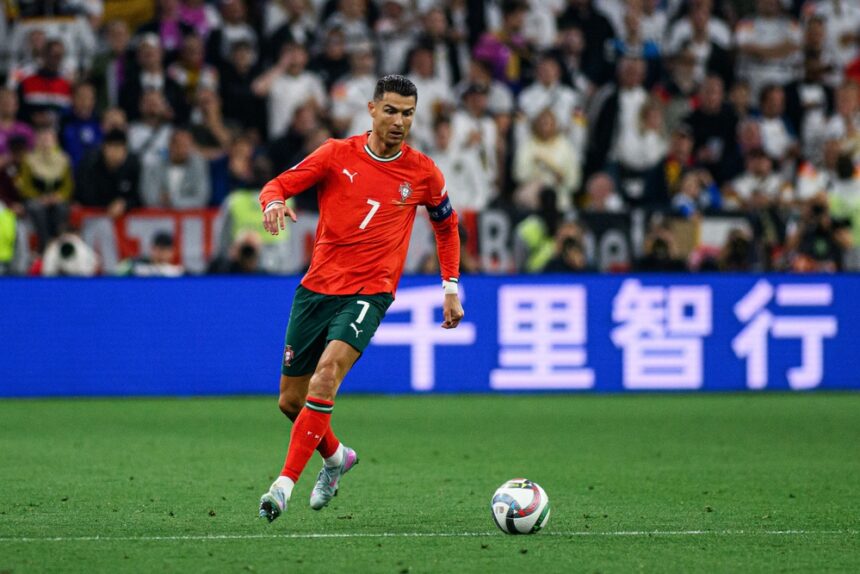
Portugal’s 2026 World Cup campaign began with six minutes of near-perfect football and spent the remaining 84 looking for a way back to that level, ending in a 1-1 draw against Congo DR that immediately reopened one of the most uncomfortable conversations in European football about whether Cristiano Ronaldo should continue starting for his country at a major tournament.
The match in Houston offered a compressed portrait of everything that has made Portugal both compelling and frustrating in recent years. An early header gave them a lead built on dominant possession and crisp passing, and then Congo DR settled into the match, equalized from a corner before halftime, and finished the game having created more shots, more shots on target, and a higher expected goals figure than the supposed favorites. Portugal managed just six shot attempts after taking the lead, a passivity that their opponents were happy to encourage.
Ronaldo’s numbers tell a difficult story
Ronaldo, 41, played the full 90 minutes in what was his sixth World Cup, a historic appearance that took place less than 24 hours after Lionel Messi, Erling Haaland, and Kylian Mbappe all scored multiple goals in convincing victories for their respective teams. The contrast was difficult to ignore.
His statistical output against Congo DR was minimal across almost every measurable category. He recorded three shot attempts, created no chances for teammates, completed two progressive carries and two progressive passes, both among the lowest totals of any Portuguese starter, and made no defensive interventions. His physical battles against Congo DR’s defenders produced no meaningful advantages, and on the occasions when teammates created openings for him on the edges of the penalty area, the resulting efforts were unconvincing.
The pattern is not a one-match phenomenon. Since scoring from the penalty spot in Portugal’s opening World Cup match in 2022, Ronaldo has gone 10 consecutive games across World Cup and European Championship competition without finding the net. His last open-play goal in a major international tournament came nearly five years ago.
Statistics that complicate the selection argument
The numbers that have accumulated around Ronaldo’s Portugal starts are significant enough to be difficult to set aside. In the past two years across all competitions, Portugal have averaged 1.9 goals per game with him in the starting lineup compared to 2.8 without him, a gap that persists even accounting for outlier results. In their previous four matches at major competitions with Ronaldo playing the vast majority of available minutes, Portugal scored just once.
At the same time, the historical case for him remaining in the team is not without merit. Since his first World Cup in 2006, Portugal’s record when he scores is dramatically better than when he does not, a correlation that coaches have used to justify keeping him on the pitch in hopes that the next goal is always one good chance away.
Portugal’s coach made no move to substitute Ronaldo throughout the Congo DR match, bringing on a replacement striker in the final minutes but removing a midfielder rather than his veteran center forward. Asked repeatedly about Ronaldo’s role after the match, the coach deflected, suggesting the team had not done enough to create the right service rather than questioning whether the striker himself was the issue.
A Plan B that has never materialized
The deeper problem Portugal face is structural. Their backup center forward came on in the 83rd minute but only because a midfielder was withdrawn, not because there was any tactical decision to change the attacking dynamic. After years of building around Ronaldo, the coaching staff appears to have no clearly developed alternative approach for games where he is not producing.
Portugal remain in a group they were expected to win comfortably. Whether this result prompts a genuine reassessment of Ronaldo‘s role or whether the coach continues to hope that one sharp performance will vindicate the decision to keep him central to the system is a question that will define this team’s tournament.