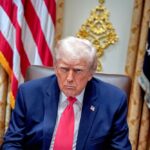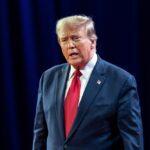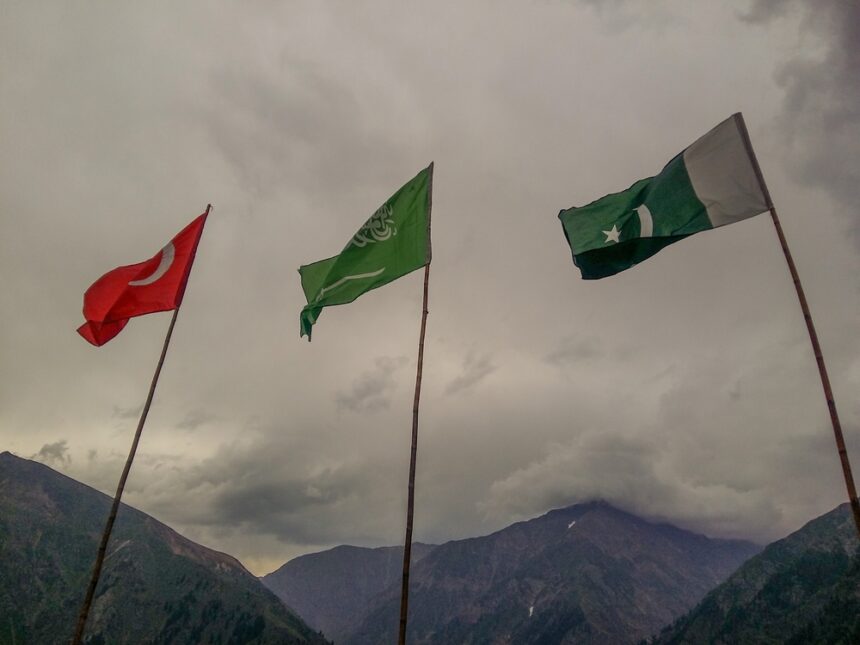
President Trump welcomed a new collective defense agreement signed by Saudi Arabia, Turkey and Pakistan, calling it a major step toward stability in the Middle East and a big, bold and important first step toward greater regional self-sufficiency in security.
The Makkah Joint Defence Agreement was signed in Mecca on Aug. 7 by Saudi Crown Prince Mohammed bin Salman, Turkish President Recep Tayyip Erdogan and Pakistani Prime Minister Shehbaz Sharif. It commits the three countries to regard an armed attack against any one of them as an attack against all, a mutual defense framework modeled on the principle found in NATO’s Article 5.
Trump posted on Aug. 16 that he was very happy to see the three countries had signed the agreement and that it demonstrated how the Middle East is coming together and how countries will finally be able to defend themselves in a more meaningful way.
What the agreement covers
The mutual defense clause at the center of the Makkah agreement is the key structural element. By committing each signatory to treat an attack on the others as an attack on itself, the pact creates a deterrence architecture that would, at least in principle, require any adversary to calculate the combined military weight of all three countries before acting against any one of them.
Saudi Arabia, Turkey and Pakistan collectively represent three of the largest Muslim-majority nations by population and economic output, and each brings distinct military capabilities to the arrangement. Saudi Arabia has a large and well-funded military and significant oil wealth. Turkey has the second-largest military force in NATO. Pakistan has nuclear weapons and one of the larger conventional armies in the world.
The regional and geopolitical significance
The timing of the agreement, amid the ongoing U.S.-Iran conflict that has disrupted oil flows through the Strait of Hormuz and raised tensions across the broader Middle East, gives the pact an immediate context. Neither Iran nor Israel is part of the agreement, and the signing in Mecca carries symbolic weight given that city’s centrality to Islam.
Turkey’s membership complicates simple characterizations of the pact. Turkey is a NATO member and has significant existing defense obligations to the Western alliance. A separate mutual defense commitment to Saudi Arabia and Pakistan introduces potential points of tension that will be watched carefully by European NATO members.
Pakistan’s nuclear status is also a factor that analysts will note when assessing the pact’s implications. Pakistan’s inclusion in a mutual defense framework means that a conflict involving Saudi Arabia or Turkey could theoretically involve a nuclear-armed state, a consideration that affects how seriously any potential adversary weighs the deterrence calculus.
Trump’s endorsement and what it signals
Trump’s enthusiastic endorsement of the agreement, delivered without apparent reservation about its implications for U.S. allies or existing regional commitments, reflects Trump’s consistent framing of countries taking responsibility for their own defense as a positive development regardless of the specific configuration.
Trump’s language about the Middle East coming together and countries defending themselves more meaningfully echoes his broader worldview about burden-sharing, applied to a region that has been central to American foreign policy for decades. Whether the Makkah agreement strengthens or complicates Trump’s strategic interests in the region will depend on how the three countries define their obligations under it and in which circumstances they choose to invoke it.
The pact is new enough that its practical dimensions remain to be established, and Trump‘s endorsement is the clearest American signal of where the administration stands. What matters for now is that three significant regional powers have formalized a commitment to each other’s security, and Trump has expressed approval.