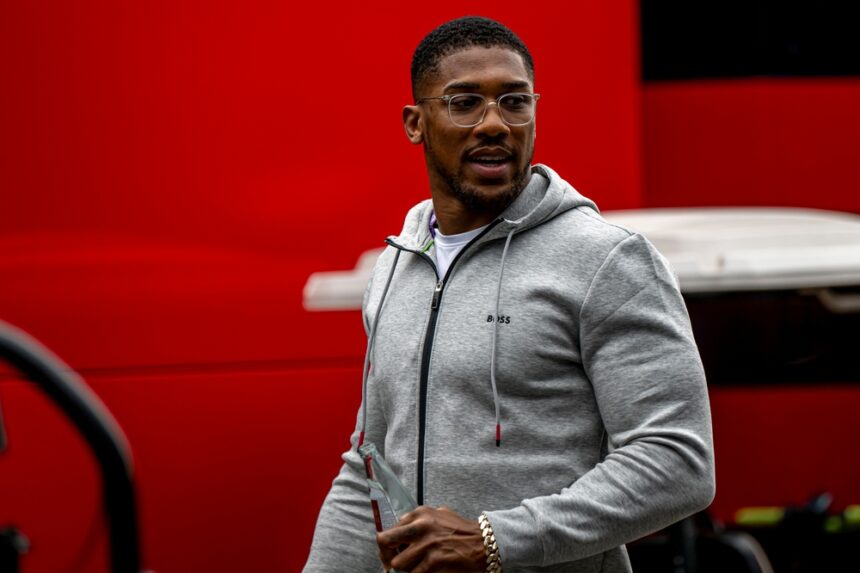
Last December, Anthony Joshua was involved in a car accident near Lagos, Nigeria, that killed two of his closest friends and teammates. The vehicle they were all traveling in struck a stationary truck on a major road, and the two men who did not survive were people Joshua had trained alongside and spent years building a career with. He sustained moderate injuries himself and spent the months that followed in a place of grief, recovery and quiet uncertainty about what would come next.
For a while, the question of whether Joshua would ever return to professional boxing felt genuinely open. The accident was not just a physical event but a rupture in the fabric of his daily life. The people he had lost were not peripheral figures. They were part of the inner world that makes a fighter’s career possible.
Joshua answers the hardest question
When Joshua addressed reporters this week in London, the question many wanted answered most was the simplest and most human one. Had he ever thought about quitting? His answer was immediate and clear. He had not, because boxing is not merely a profession for him but something closer to a calling. He described the sport as therapeutic, as something that gives fighters structure and meaning beyond competition. For Joshua specifically, the gym is the place where he feels most himself, most grounded, most at peace.
That framing matters because it reframes what this comeback actually is. It is not a financial decision or a contractual obligation. It is a man returning to the thing that makes sense to him when very little else does.
The road back to the ring
Joshua is scheduled to return to competitive boxing on July 25 in Jeddah, Saudi Arabia, where he will face Kristian Prenga, an unbeaten Albanian heavyweight with a record built almost entirely on stoppages. The fight is designed as a re-entry point, a moment to shake off the rust and re-establish rhythms before something bigger.
That bigger fight is a potential clash with Tyson Fury, a showdown being targeted for November that would be one of the most anticipated heavyweight matchups in years. Both men carry significant name value and unfinished business, and the commercial appetite for that fight has been building for some time.
Joshua and the Usyk effect
In preparation for his return, Joshua has been training in Spain alongside unified heavyweight champion Oleksandr Usyk. The partnership is an unusual one given that Usyk defeated Joshua twice, but the two appear to have built a genuine working relationship. Joshua described something shifting in him during those sessions, crediting Usyk’s influence with helping him rediscover a sense of mental readiness.
Part of that influence has been spiritual. Usyk is a devout Christian and prayer has become a meaningful part of Joshua’s own preparation over the past several months. Joshua does not identify with any specific religion, but he has spoken about how the practice of prayer has helped him navigate the emotional weight of this period.
Making it about others
Perhaps the most revealing thing Joshua said this week was about where he directs his emotions. Rather than processing grief inward, he has focused on the families of the two men who died. He described the parents of his lost friends as the ones carrying the heaviest burden and said his own feelings could wait. He is not making this comeback about himself. He is making it about them.
That instinct, to carry loss outward rather than inward, may be the most powerful thing Anthony Joshua brings into that ring in July.