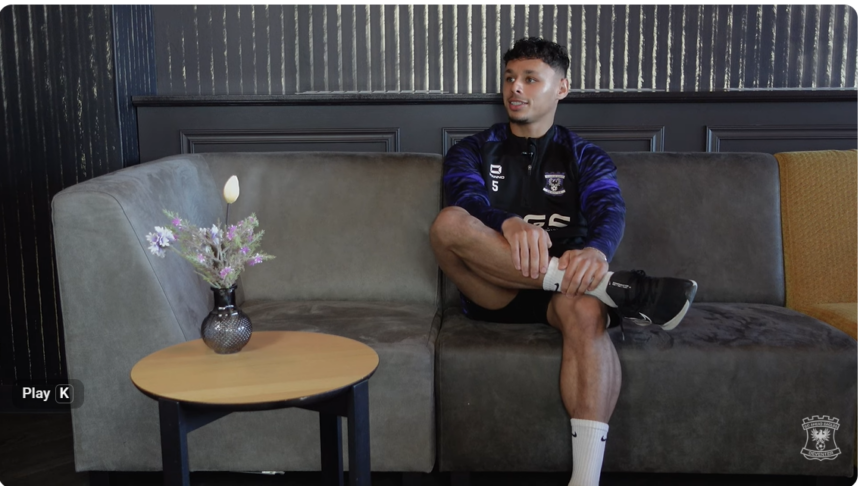
Dean James is not a name most soccer fans outside the Netherlands would recognize. The 26-year-old left back plays for Go Ahead Eagles in the Dutch Eredivisie, and until recently, his biggest headline was agreeing to represent Indonesia at international level. Now he sits at the center of a legal dispute that has the potential to send an entire professional soccer season into chaos.
A court in Utrecht heard the appeal in the case between NAC Breda and the KNVB, and the ruling could result in at least 133 Eredivisie matches being replayed. That is not a typo.
How the Dean James situation started
James was born in Leiden and has spent his entire professional career in the Dutch league system. When Indonesia approached him in February 2025 about representing the national team, he accepted. He earned five caps, with his debut coming on March 20, 2026, in a defeat to Australia.
What James and his club apparently did not know was that accepting an Indonesian passport may have constituted a renunciation of his Dutch citizenship. Under Dutch law, losing that citizenship reclassifies a player as a foreign national, which means working in the Netherlands requires a valid work permit. James did not have one.
On March 15, Go Ahead Eagles defeated NAC Breda 6-0. James played. Days later, a Dutch podcast called ‘De Derde Helft’ aired a segment in which commentator Rogier Jacobs laid out what that might mean. The argument was straightforward. If James had unknowingly given up his Dutch citizenship by obtaining an Indonesian passport, he was technically ineligible to play in that match, and NAC could challenge the result.
The legal argument at the core of the case
Professor Marjan Olfers, a sports law expert, spelled out the stakes in an interview with ESPN. When a player renounces Dutch citizenship, they move into a different legal jurisdiction. They become, under Dutch law, a foreigner. That status triggers work permit requirements for professional employment, including playing soccer.
NAC Breda filed a complaint with the KNVB four days after the podcast aired. The Dutch football association and the Eredivisie supervisory board rejected the request to replay the match, citing the fact that neither James nor Go Ahead Eagles had any knowledge of the eligibility issue at the time.
NAC pushed forward anyway, taking the matter to court.
25 players, 133 matches and a potential scheduling collapse
What began as a complaint about one match has since expanded significantly. Around 25 players are now caught up in the same eligibility questions, all of them linked to decisions to represent Indonesia, Suriname, or Cape Verde. Those three countries share colonial and historical ties with the Netherlands, and players with roots in those nations have increasingly pursued international opportunities there. None of them, it appears, were warned about the citizenship implications.
The KNVB has made clear what it fears most. If the Utrecht court rules in NAC’s favor, every club that lost to a team fielding one of these players gains the legal standing to file its own appeal. That creates a chain reaction involving at least 133 matches across the season. Replaying all of them before the conclusion of the Eredivisie campaign, with the 2026 FIFA World Cup approaching this summer, is a logistical situation the KNVB has described as one that could prevent the competition from finishing at all.
What the ruling could mean for Dutch soccer
Marianne van Leeuwen, speaking for the KNVB, has expressed concern that a ruling against the federation could effectively halt the league. The timing is particularly difficult. The Eredivisie runs deep into spring, and World Cup preparations add pressure to an already compressed calendar. Any large-scale replay schedule would require renegotiating broadcast deals, stadium bookings, and player availability during a period already stretched thin.
For clubs not directly involved in the James situation, the anxiety is about precedent. A ruling that opens the door to result reversals based on work permit technicalities creates a new layer of legal vulnerability that nobody in the league was accounting for at the start of the season.
James, for his part, appears to have been as blindsided as anyone. His club director reportedly had to inform him that a complaint had even been filed.
The court’s decision will define what comes next. For now, Dutch soccer is in a holding pattern, waiting to find out whether one left back’s passport paperwork could undo months of competition.