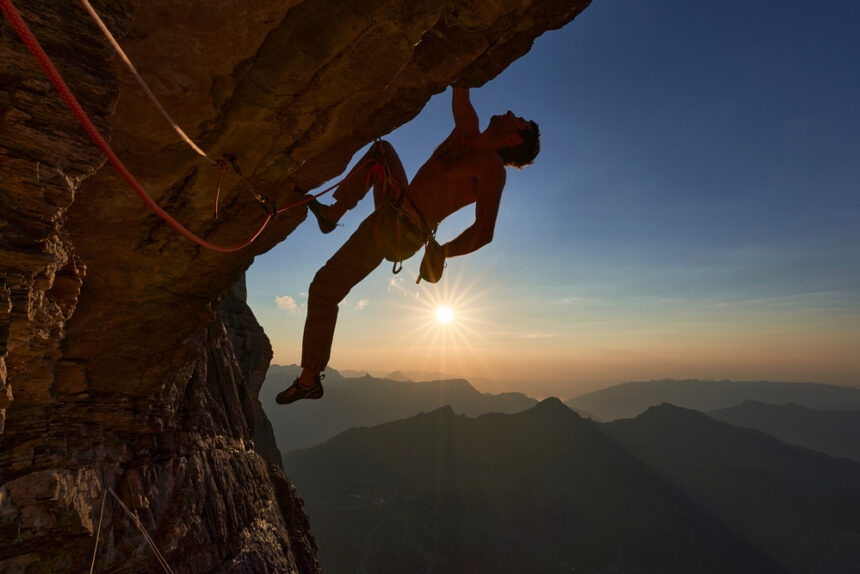
There is a moment on the wall — fingers curled into a narrow pocket of stone, body suspended between sky and silence — when everything else disappears. The noise of the street below, the weight of expectation, the long history of who was and wasn’t supposed to be here. It is just you, the rock, and the route ahead. That moment, raw and clarifying, is what makes climbing one of the most quietly radical sports alive today.
For decades, climbing existed at the fringes of mainstream culture, practiced by a relatively narrow community. That is changing — and the shift goes far beyond gym memberships or Olympic medals.
A sport in the middle of something big
The numbers tell part of the story. The global climbing gym market, valued at roughly $3 billion in 2024, is projected to reach $7.6 billion by 2034. Participation figures in the U.S. crossed 10 million in 2021. Indoor bouldering — the rope-free format where climbers work short, powerful sequences on lower walls — is growing at roughly 20 percent annually, faster than nearly any other segment. These are not fringe figures. Climbing is experiencing a genuine cultural moment.
The 2024 Paris Olympics accelerated much of it, placing competitive climbing in front of a global audience and introducing the sport’s full-body demands to millions who had never considered the wall. Gyms across the country reported surges in first-time visitors following televised coverage, and the demographic profile of who walked through those doors began to shift in ways the sport had not seen before.
The wall as a place of possibility
For much of its organized history, climbing existed as a predominantly white, relatively affluent pursuit — a perception shaped not only by the sport itself but by who had access to public land, gear, transportation, and the unspoken social capital that comes with belonging. Urban climbing gyms, whatever their original intent, began disrupting that pattern. By placing walls inside cities, climbing found itself inside communities it had never meaningfully reached.
New gyms opening in neighborhoods like Oakland and Harlem are not simply expanding a market. They are creating physical spaces where young people who might never have driven three hours to a canyon can now encounter climbing on their own terms — after school, on weekends, in their own zip codes. The wall, in this context, becomes something more than training infrastructure. It becomes an entry point to a different kind of future.
Organizations like Climbing for Change, founded by pro climber Kai Lightner, and Brown Girls Climb have spent years building the scaffolding around that future — connecting underserved communities with mentors, grants, and professional pathways in the outdoor industry. Climbers of Color, a grassroots group staffed entirely by BIPOC guides and instructors, has insisted on developing leaders, not just participants. The distinction matters: representation at the entry level is a starting point, never an endpoint.
Climbing as something deeper than sport
What those organizations understand — and what the broader climbing world is slowly learning — is that the sport carries meaning beyond the physical act. The route up the wall is also a route through something older and more stubborn: the mythology that demanding outdoor pursuits were built for certain people and not others.
That mythology has always been fiction. Communities with deep ties to land and landscape were present in these spaces long before organized adventure sports gave them formal names. What changed was not presence, but visibility. The narrative of who belongs outdoors is being rewritten, and climbing is one of its most vivid chapters.
At Climb Fest 2025, hosted by The North Face in San Francisco, a 45-foot wall erected above the city’s waterfront drew crowds that reflected what the sport could look like when fully opened. Organizations such as Negus in Nature have worked to make that vision explicit — dismantling the idea that outdoor culture belongs to any single group, while making space for the specific textures and energies that different climbers bring with them.
What climbing demands — and what it returns
Climbing is not a passive sport. It requires spatial reasoning, raw strength, flexibility, and a particular tolerance for discomfort and risk. A 2024 study found that climbing may offer protective benefits against anxiety disorders in adolescents. An earlier analysis of nearly 600 participants concluded that therapeutic climbing produced measurable improvements in physical, mental, and social well-being. The research is still developing, but the anecdotal case has long been clear to anyone who has stood at the base of a route that seemed impossible and found a way through.
That experience — confronting a problem with your whole body, adjusting, failing, trying again — does not belong to any one demographic. It is available, in theory, to anyone willing to step onto the wall. The work happening right now in climbing is the work of making that theory real: removing the financial, geographic, cultural, and social barriers that have kept the sport smaller and less representative than it has any reason to be.
Youth scholarship programs, affinity climbing events, BIPOC guide development pipelines, and community-centered gym programming are all expanding. The sport is beginning to understand that its future does not look like its past. That is not a loss. It is the most important route the climbing world has ever attempted — and more people than ever are reaching for it.