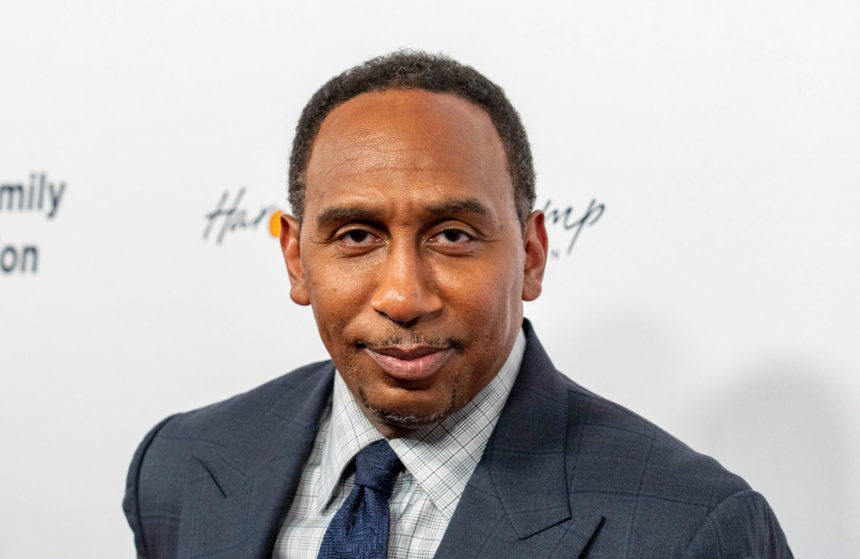
Stephen A. Smith has never been one to hold back an opinion, but political commentary is a lane he has generally approached with some caution. That caution appeared to dissolve during a recent appearance on a national cable news program, where he addressed Donald Trump directly and with a sharpness that quickly drew attention well beyond sports media.
The immediate trigger was an AI-generated image Trump posted on his Truth Social platform depicting him in a white robe in what appeared to be a hospital or medical setting, surrounded by figures including military personnel and a praying woman. The image was widely interpreted as presenting Trump in a messianic or Christ-like light. It drew immediate and broad criticism before being deleted from the platform.
What Smith said and why he said it
Smith’s response to the image was not limited to the post itself. He used the moment to speak to what he described as a broader and deeply concerning pattern. He framed his comments carefully, acknowledging that he does not approach the president with an intent to speak disparagingly, but that there are moments when staying silent feels untenable. The image, in his view, was one of those moments, not because of the image alone but because of what it represented alongside a long series of statements he described as false and delivered without apparent concern.
His language was direct and unambiguous. He described the ease and frequency with which misleading statements appear to flow from the president as genuinely alarming, the kind of thing that demands a response precisely because of the office from which they originate.
Trump’s explanation for the deleted image
Trump did not leave the controversy unaddressed. He offered a public explanation for the intent behind the post, stating that the image was meant to convey a connection to humanitarian work rather than any religious symbolism. He described the framing as being about medical or relief-oriented service and expressed frustration at what he characterized as a deliberate misreading of the image by media outlets he considers hostile to his administration.
Whether that explanation satisfied critics is another matter. The image had already been removed by the time the explanation circulated, and the backlash had moved well past the point where a single statement could fully contain it.
A broader moment of friction with religious leadership
The episode arrived in the middle of a broader period of friction between Trump and religious institutions. Around the same time the image circulated, Trump publicly criticized Pope Leo over comments the pontiff had made regarding the ongoing conflict with Iran, describing the pope’s stance on related issues as weak and misaligned with sound foreign policy. The combination of the AI image and the papal criticism intensified public conversation about how the administration engages with religious symbolism and religious authority.
Smith’s decision to wade into that conversation from his platform in sports media is itself notable. His audience skews away from the kind of political programming where this kind of commentary is expected. Choosing to make these remarks in that particular context and directing them at the president by name signals something beyond a casual opinion. It was a deliberate choice to use a very large platform for something he clearly felt could not wait for a more conventional venue.
Whether Smith continues down this path or returns to keeping his political commentary more contained remains to be seen. But the remarks landed, spread quickly, and put him at the center of a conversation that is almost certainly going to grow louder before it quiets down.