

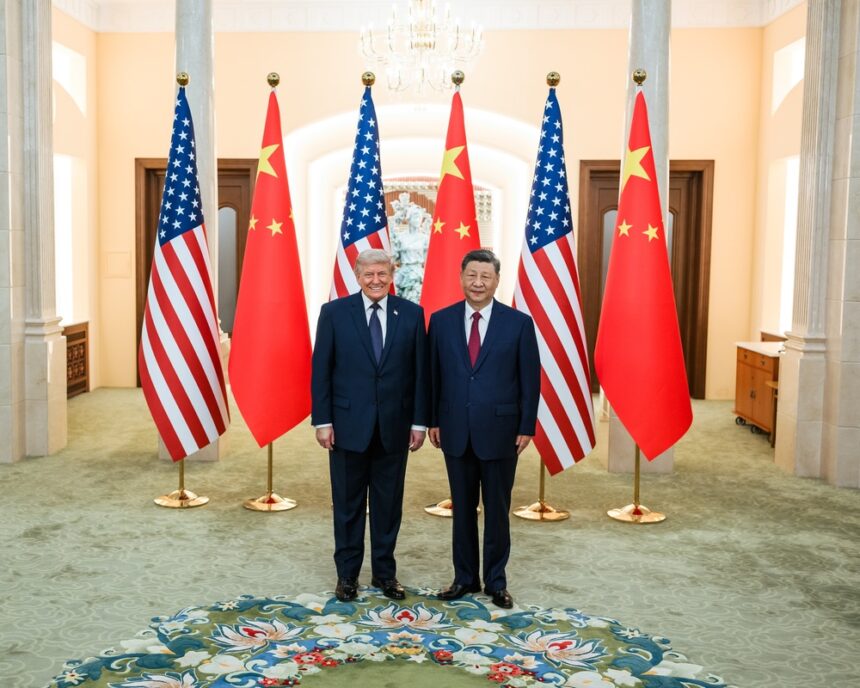
The leaders of the United States, China and Russia agreed to a four point peace declaration on Thursday, stating that a nuclear war cannot be won and must never be fought.
The statement capped a historic trilateral summit in Shenzhen, China, between President Donald Trump, Chinese leader Xi Jinping and Russian President Vladimir Putin. The peace declaration was the main outcome of the first meeting of the three leaders.
What does the peace declaration say?
The leaders pledged dialogue on reducing nuclear risks and preventing the spread of nuclear weapons. Preventing the spread of nuclear weapons has taken on new urgency amid the war with Iran and North Korea’s growing arsenal.
The declaration also calls for reforming the United Nations so it can respond more effectively to global challenges and better serve its core mission of international peace and security. All three countries are permanent members of the U.N. Security Council. The three countries hold veto power on the council, which has often been deadlocked on major crises.
It commits the three nations to boost production and supply of refined petroleum products and reaffirms the importance of stable energy flows. Earlier reports described the energy pledge as a plan to boost oil supply for the benefit of countries around the world.
Where does the nuclear war language come from?
The phrase that a nuclear war cannot be won and must never be fought dates to a 1985 joint statement by President Ronald Reagan and Soviet leader Mikhail Gorbachev.
The five permanent Security Council members repeated it in a joint statement in January 2022.
Repeating it now carries weight because the New START treaty, the last major limit on U.S. and Russian arsenals, expired earlier this year. Russia has also suspended participation in some earlier arms control arrangements.
China has long resisted arms control talks with Washington and Moscow, arguing its arsenal is much smaller. Getting Beijing to sign on to any nuclear language with both powers is notable on its own.
Why does the oil pledge matter?
Energy prices have been pushed higher by the war with Iran and recent attacks in the Persian Gulf, including drone strikes on Kuwait and Bahrain this week.
More refined fuel could help ease gasoline and diesel prices, a key concern for American families and businesses. Gas prices have been a top concern for American voters.
The peace declaration did not detail how much additional supply each country would provide.
How was the peace declaration released?
Russia’s and China’s foreign ministries published nearly identical versions of the joint declaration. The White House is expected to release its version later. The matching texts suggest the wording was negotiated in advance.
The meeting ended shortly before 6 p.m. local time, and Trump left for Washington on Air Force One about an hour later.
It was the first time the leaders of the three nations had met together. The summit capped Trump’s Asia trip, which included stops in the Philippines and talks with Xi.
What comes next?
The peace declaration commits the three powers to talk, but it does not set specific targets or timelines for cutting nuclear weapons.
Supporters say restarting dialogue among the three nuclear powers is a meaningful first step. Critics say the statement is largely symbolic without enforceable commitments. Some analysts say the language on U.N. reform could signal a push to reshape global institutions.
How the peace declaration is put into practice will be watched closely in Washington, Beijing and Moscow. For now, the peace declaration marks a rare moment of agreement among three rival powers.