

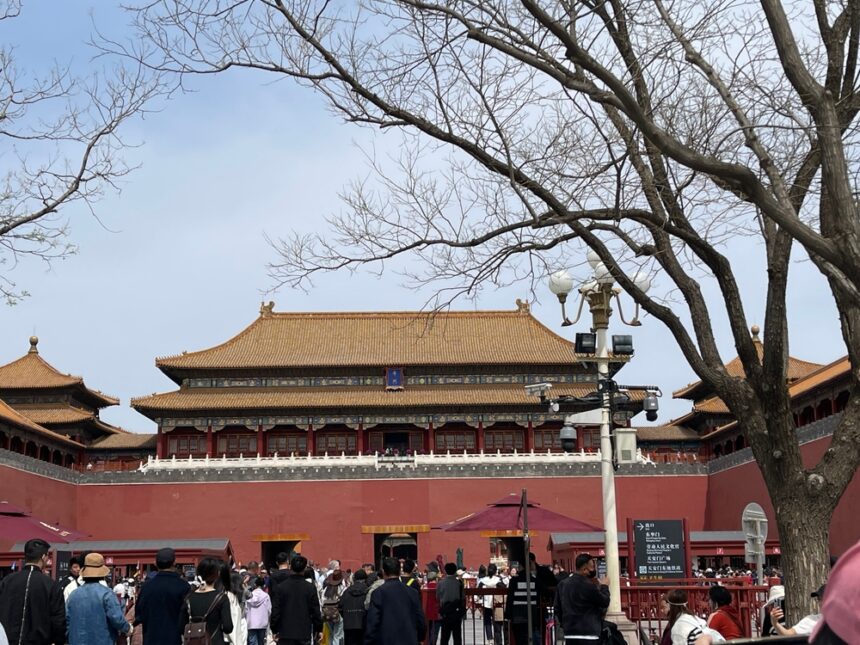
As China’s top leaders met behind closed doors, residents of the capital say the streets outside felt more closely watched than ever.
Beijing security tightened during the Chinese Communist Party’s Fifth Plenum, held Oct. 26 to Oct. 29, 2026, with residents reporting more street patrols, new surveillance cameras and stronger efforts to detain people seeking to file complaints with authorities.
What are residents seeing?
Residents told The Epoch Times that uniformed personnel, including people who identified themselves as members of a militia, have been deployed alongside elderly neighborhood volunteers to watch the streets and question passersby. They spoke on condition of anonymity, citing fear of reprisal.
One Beijing resident said security had grown stricter since China’s National Day holiday on Oct. 1 and especially during the plenum. National Day marks the founding of the People’s Republic of China in 1949.
She said some security personnel had switched into green uniforms and identified themselves as militia members. Volunteers in their 60s and 70s, wearing blue shirts and armbands, were also patrolling neighborhoods.
Security workers are everywhere, she said, describing it as a nationwide mobilization in which everyone has been put on duty. Residents said the volunteers stopped and questioned people on the street.
The accounts could not be independently verified.
Why is Beijing security tight during the plenum?
Beijing security often increases around major political events, including the annual legislative meetings and party gatherings, as authorities seek to prevent protests or disruptions. During such events, visitors to Beijing can face extra identity checks, and some deliveries and gatherings can be restricted.
A plenum is a full meeting of the party’s Central Committee, the group of top officials that sets broad policy. This year’s meeting has focused on party discipline and internal governance, even as China faces a slowing economy and a sharp drop in technology stocks. Plenums are held several times between party congresses, which take place every five years.
What is petitioning in China?
Petitioning is an official process that allows people to seek help from higher authorities over grievances such as land seizures, unpaid wages or local corruption. The system dates back decades and was meant to give ordinary people a way to raise complaints outside the courts.
In practice, rights groups say petitioners are often harassed, detained or sent back to their hometowns, particularly when they travel to Beijing during sensitive political periods. Some have reported being held in unofficial detention sites. Human rights organizations have documented these practices for years.
Residents said petitioners faced especially strict controls under the Beijing security push during the plenum.
Who are the neighborhood volunteers?
China has long relied on volunteer networks of retirees and residents to help watch neighborhoods, especially in Beijing. Wearing armbands, they report suspicious activity and help keep order during big events. One widely recognized group, made up largely of retirees in Beijing’s Chaoyang district, has been praised by police for passing along tips.
Supporters describe the volunteers as community safety helpers, while critics see them as part of a broad system of public surveillance. The Chinese government says such measures help keep communities safe.
China operates one of the world’s largest networks of surveillance cameras, and Beijing security relies heavily on that technology.
What does the Beijing security effort show?
The tight Beijing security reflects the party’s focus on stability during important political moments, according to analysts who study China. Analysts say keeping order in the capital is a top priority whenever leaders gather.
It remains to be seen whether the extra patrols and controls ease after the plenum wraps up.
For many in the capital, heightened Beijing security has become a familiar part of political life.