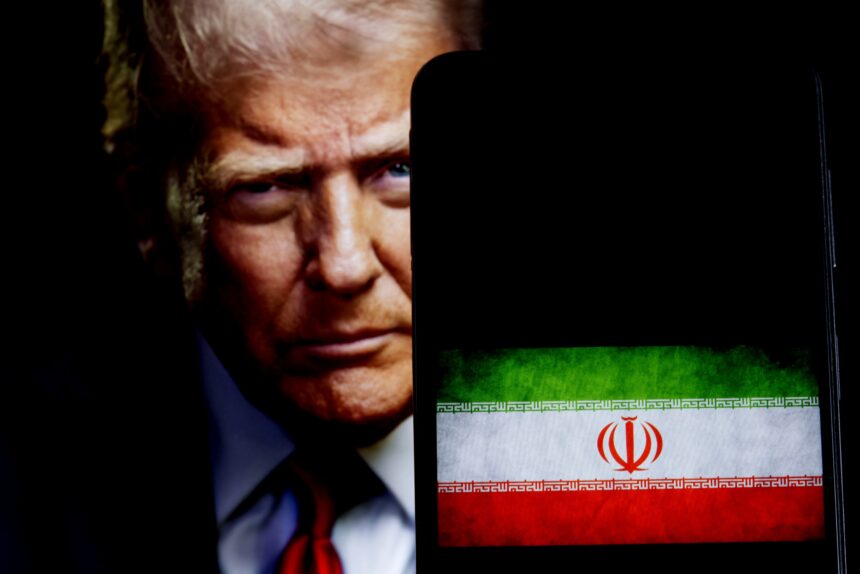
President Donald Trump declared Saturday that a deal to end the war with Iran would be signed the following day, setting off a fresh round of diplomatic uncertainty as Iranian officials pushed back on the timeline and signaled that no final decision had been made.
In a post on his Truth Social platform, Trump said the agreement was on track for Sunday and that one of its most consequential provisions would take effect almost immediately afterward. The Strait of Hormuz one of the world’s most critical waterways for global oil shipments would be reopened to all traffic as soon as the deal was signed, he said.
Trump also gestured toward a longer-term arrangement in which the United States would eventually assist in removing enriched uranium from Iran, though he offered no specific date or details on how that process would unfold. He closed the post with what many observers interpreted as a thinly veiled warning, suggesting that if the process did not proceed smoothly, an unspecified alternative remained available one he described as something he hoped would never be used again.
Iran signals caution, says reviews are still underway
Iranian officials moved quickly to temper expectations. The country’s Foreign Ministry spokesperson, quoted by state media on Saturday, indicated that the exact date of any signing was not yet confirmed and suggested the following day was not realistic. A source described as close to Iran’s negotiating team, cited by the Fars news agency on Sunday, went further, saying that Iran had not yet reached a final decision on the proposed understanding with the United States and that political, legal and technical reviews of the proposals were still actively underway.
The contrast between Trump’s confident public declaration and Iran‘s measured response illustrated the fragile and still evolving nature of the negotiations, which have unfolded rapidly against the backdrop of what had been a tense and militarily charged standoff between the two countries just days earlier.
Regional players signal support for a deal
While the two primary parties remained publicly at odds over timing, diplomatic activity in the region pointed toward genuine momentum. Pakistani Prime Minister Shehbaz Sharif said Saturday that the U.S. and Iran were closer to a peace agreement than they had ever been, describing a finalization as likely within 24 hours while also noting that technical level talks were expected to continue into the following week. Trump reposted those remarks on his Truth Social account, amplifying them to his own audience.
Pakistan’s Deputy Prime Minister Mohammad Ishaq Dar added that he had spoken with Saudi Arabia’s foreign minister, Prince Faisal bin Farhan, about the agreement. Saudi Arabia, he said, welcomed the negotiations and expressed hope that the development would contribute to lasting peace and stability across the broader region.
What the deal would mean
Senior Trump administration officials acknowledged Friday that the U.S. was not entirely certain the agreement would actually be signed as described. But they outlined what the deal would look like in its current form: a framework designed to guarantee long term peace in the region, paired with significant economic relief for Iran a country that has endured years of sanctions that have severely constrained its economy and limited its access to global markets.
The Strait of Hormuz, which sits between Iran and the Arabian Peninsula, is the passage through which roughly 20% of the world’s oil supply travels. Any prolonged closure or disruption of that waterway carries enormous consequences for global energy markets, making its reopening one of the most watched elements of the proposed agreement.
As of Sunday, the White House had not publicly clarified the specific terms of Trump’s remarks, and no signing ceremony had been confirmed. The situation remained fluid, with both sides publicly committed to a deal in principle while still navigating the distance between an announcement and a signature.