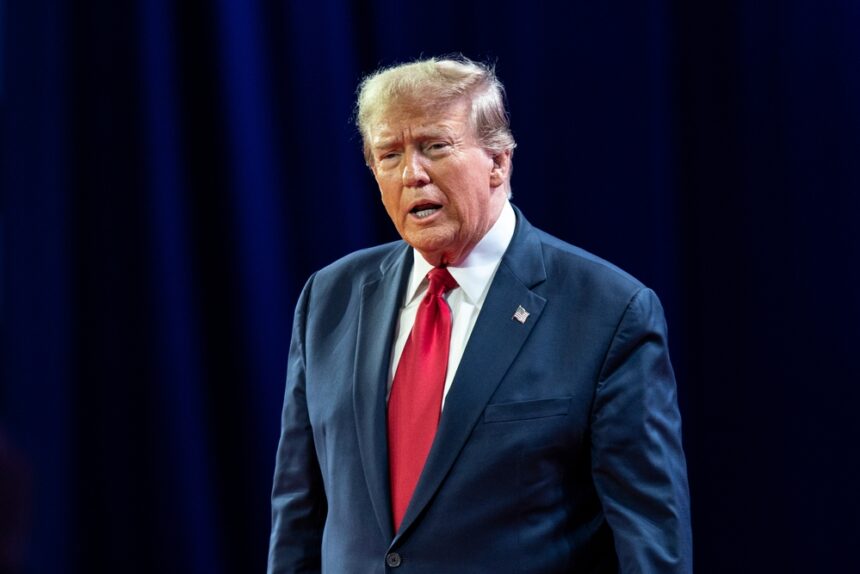
President Trump said Sept. 16 that if the proposal for Canada to join the European Union as an associate member is intended as a hostile act against the United States, he would impose heavy tariffs on Europe or potentially cut off trade with the bloc in some areas.
Trump was asked about European Commission President Ursula von der Leyen’s proposal for Canada to become an EU associate member while speaking to reporters in Charlotte, N.C., on the way to a campaign rally in support of Republican Senate candidate Michael Whatley.
He called the idea laughable and described the northern neighbor as a terrible trade partner. He said the consequences would depend on the intent behind the proposal. If the intention is good, he said, that is fine. If it is a hostile act, he said he would put very heavy tariffs on Europe.
Also on Sept. 16, Trump signed an executive order enacting a previously announced commitment to ban Canadian goods from certain U.S. federal procurement contracts.
The EU associate membership proposal
Von der Leyen proposed the Canada associate membership as a framework for closer ties with the European Union without full membership, which is reserved for European nations. The proposal comes amid elevated trade tensions following the imposition of U.S. tariffs on goods from Ottawa earlier this year.
Whether the associate membership would constitute an economic or strategic challenge to U.S. interests depends on the specifics of any eventual agreement, which have not been detailed. Trump’s comments suggest the administration is treating the proposal as a potential provocation rather than a routine diplomatic development between allied nations.
The tariff backdrop
U.S. trade relations with its northern neighbor have been strained since Trump’s second term began. Ottawa imposed $20 billion in retaliatory tariffs on U.S. goods in September. The federal procurement ban signed Sept. 16 adds another layer of economic pressure.
Trump’s threat to extend tariffs to Europe over the Canada-EU membership question would represent a significant escalation, targeting a trade relationship that accounts for hundreds of billions of dollars annually. The European Union and the United States have their own history of trade disputes, but a direct tariff threat tied to Ottawa’s diplomatic positioning is a new element.
What comes next
Neither the European Commission nor Ottawa had publicly responded to Trump’s Sept. 16 remarks at the time of this report. The Canada-EU associate membership proposal is early-stage and would require formal negotiations before any agreement could take shape.
Trump‘s language of hostile intent and heavy tariffs signals the administration intends to treat the country’s European diplomatic alignment as a factor in its broader trade posture, not a matter separate from the bilateral relationship.